



Study: eSIM Activation Trends Among Travellers
https://www.zimconnections.com/study-esim-activation-trends-among-travellers/
 SHARE
SHARE
eSIMs are transforming the way travellers stay connected. By mid-2025, 19% of global travellers used eSIMs, rising to 26% for multi-country trips. These digital SIMs eliminate the need for physical cards, offering instant activation, cost savings (up to 90% on roaming fees), and seamless connectivity across borders. UK travellers are particularly drawn to eSIMs for their convenience, affordability (plans often cost £10–£25), and ability to maintain their UK number for essential calls or texts.
Key Takeaways:
- Global growth: eSIM users expected to grow from 40 million in 2024 to 215 million by 2028.
- Convenience: Pre-trip activation ensures instant connectivity upon arrival.
- Affordability: Regional eSIMs cover multiple countries, avoiding roaming fees.
- Demographics: Millennials and Gen Z lead adoption, with 71% and 69% considering eSIMs.
- Challenges: Limited awareness, device compatibility, and concerns about support remain barriers.
Platforms like ZIM Connections simplify eSIM activation with prepaid plans covering over 200 destinations, helping travellers stay connected with ease. Whether for business, leisure, or multi-country trips, eSIMs are becoming a travel essential.
eSIM Adoption Statistics and Growth Trends for Travelers 2024-2028
Global eSIM Adoption Trends
Adoption Rates and Growth Over Time
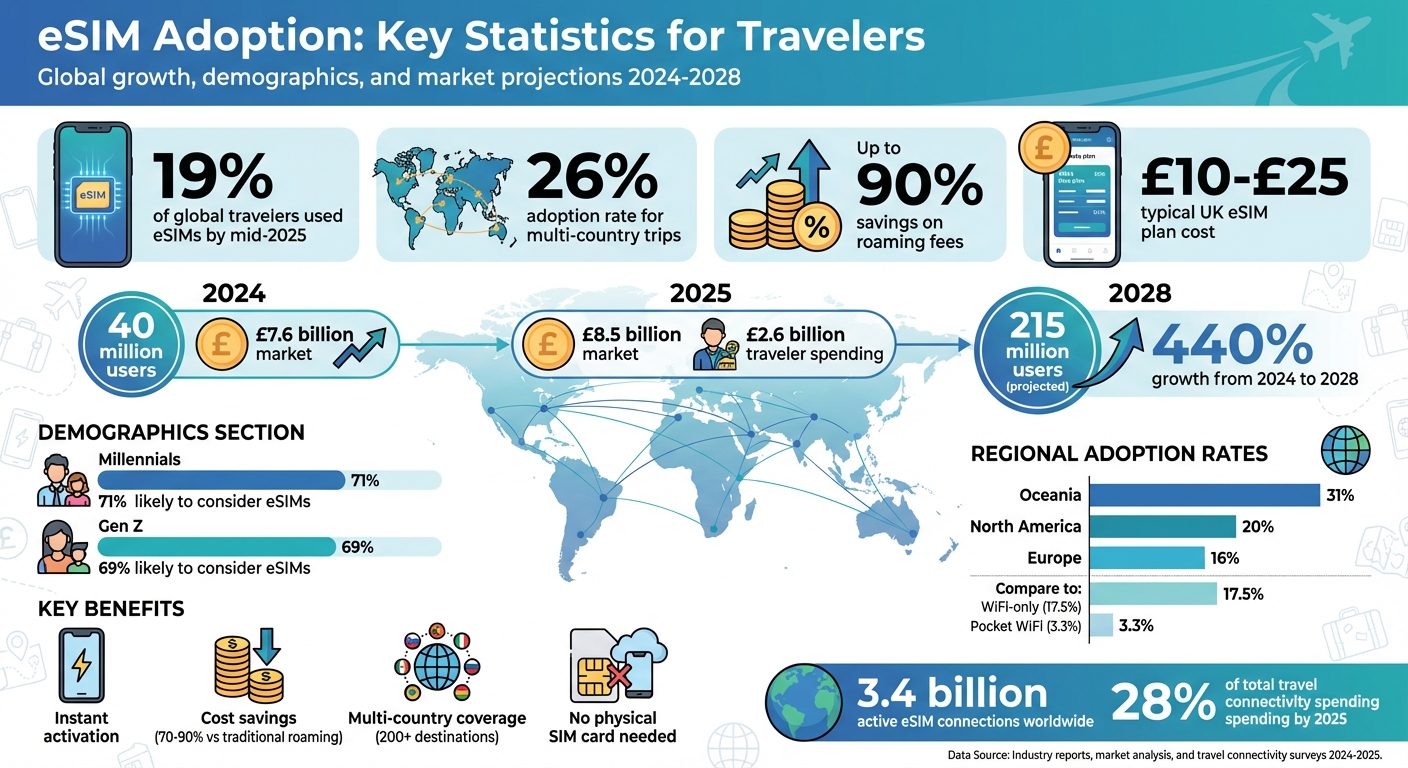
By mid-2025, 19% of global travellers were using eSIMs for connectivity, surpassing both WiFi-only options (17.5%) and pocket WiFi (3.3%). The global eSIM market saw significant growth, rising from £7.6 billion in 2024 to a projected £8.5 billion in 2025. Active eSIM connections reached an impressive 3.4 billion worldwide, with smartphone penetration estimated between 25% and 40%. Spending by travellers on eSIMs is expected to exceed £2.6 billion by 2025, growing at nearly 50% annually and accounting for 28% of total travel connectivity spending.
What’s driving these numbers? For one, the affordability of travel eSIM plans is a big factor. Most plans now cost under £12 per trip, making them an attractive option for budget-conscious travellers. Looking ahead, the number of travel eSIM users is predicted to skyrocket – from 40 million in 2024 to 215 million by 2028, marking a staggering 440% growth.
Traveller Demographics and Usage Patterns
Travellers visiting multiple countries are leading the charge in eSIM adoption. Among this group – who make up 43% of all international travellers – 26% now use eSIMs, well above the global average of 19%. The convenience of avoiding SIM card swaps has been a game-changer for these travellers.
Business travellers and digital nomads, in particular, value the uninterrupted connectivity that eSIMs provide for virtual meetings and remote work. Frequent flyers appreciate the ease of instant activation, while younger travellers, including social media influencers, rely on eSIMs for navigation and mobile payments. Even leisure travellers on shorter, multi-destination trips enjoy the predictable costs and added security that eSIMs offer.
Generational trends also highlight growing interest: 71% of Millennials and 69% of Gen Z are likely to consider using travel eSIMs for their journeys.
Regional Variations in eSIM Usage
Adoption rates vary significantly across regions. Oceania leads the pack with a 31% adoption rate, followed by North America at 20% and Europe at around 16%. In Europe, usage is somewhat tempered by "Roam Like at Home" policies, which allow travellers to use their existing plans without extra charges.
In contrast, Africa sees pocket WiFi (20%) and local SIMs (33%) as the dominant choices. Meanwhile, several Asian markets – including Malaysia, Singapore, South Korea, Australia, the UAE, Brazil, and India – are experiencing rapid growth in eSIM adoption. However, destinations like Hong Kong and mainland China still favour physical SIM cards.
Search trends in 2025 reveal growing interest in eSIMs for countries like the US, Canada, Turkey, and Japan.
"Various industry players… have introduced their own travel eSIM services… driving a shift toward eSIMs through trusted brands",
noted Nitin Bhas, Chief of Strategy & Insights at Kaleido.
The involvement of airlines, hotels, and payment companies in launching eSIM services has been instrumental in accelerating regional growth. Expanding smartphone compatibility, especially among mid-tier devices, is also helping to drive adoption. These regional patterns highlight how travellers are embracing eSIMs and adapting their connectivity habits.
How Travellers Activate and Use eSIMs
Activation Timing: Pre-Trip vs On Arrival
When it comes to eSIM activation, timing is everything for today’s travellers. Many frequent flyers, business professionals, and digital nomads now favour pre-trip activation. It’s easy to see why – landing in a new country with instant connectivity for navigation, ride-hailing, or messaging is a game-changer. Research from Europe highlights that the need for “instant, reliable connectivity” upon arrival drives many to set up their eSIM profiles before departure. Once they land, a simple toggle activates their connection. This method is especially popular for trips to tech-forward destinations like Western Europe, Japan, or Singapore.
On the other hand, many UK holidaymakers and less tech-savvy tourists opt to activate on arrival. They often complete the setup at the airport or their accommodation, using airport Wi-Fi to get started. For those on multi-country trips, mid-trip activation becomes common when they encounter unexpected roaming fees or unreliable hotel Wi-Fi. The decision between pre-trip and on-arrival activation often boils down to factors like price clarity, ease of setup, and personal comfort with technology. UK travellers, for instance, carefully compare data plans priced in GBP before deciding. For those unsure if their phone supports eSIM or worried about disrupting their primary UK line, waiting until arrival feels safer, as they can test local networks or seek assistance if needed.
Regardless of the timing, simplifying the activation process is essential, as detailed below.
Simplifying eSIM Activation Processes
The QR code setup has revolutionised eSIM activation. Providers now email or display a QR code that users can scan in their device settings to activate their eSIM in under a minute. Many travel-focused eSIM brands have incorporated this into mobile apps, where users can select a destination, pay in-app (often in GBP), and either trigger automatic installation or access their QR code. For tech-savvy users, manual entry of the SM-DP+ address and activation code remains an option.
To make the process even smoother, leading providers have introduced step-by-step onboarding tools. These include device checks to confirm eSIM compatibility, prompts explaining settings like “allow mobile data switching,” and pre-departure tests to ensure the eSIM works before leaving Wi-Fi. In-app tutorials tailored to different devices (iOS vs Android) and pre-departure checklists also help reduce activation errors and customer support requests.
Common activation hiccups include attempting setup on locked devices, scanning codes without a stable internet connection, or forgetting to disable data roaming on the home SIM – leading to unwanted charges. To avoid these issues, travellers are advised to:
- Save their QR codes and settings offline.
- Install and test the eSIM before departure, if possible.
- Keep their physical SIM active for calls and texts, while using the eSIM for data.
Device Compatibility and Profile Management
Once activated, ensuring your device supports multiple profiles is crucial for a hassle-free experience. Most travellers confirm eSIM compatibility through in-app checks or by looking for options like “Add eSIM” or “Mobile plans” in their device settings. With manufacturers increasingly shifting to eSIM-only or eSIM-first models, newer flagship phones generally support multiple profiles. However, older or budget models, and some region-specific variants, may lack this capability. UK travellers often face issues with devices purchased on instalment plans, as these can be locked or have firmware restrictions that limit eSIM functionality or network compatibility abroad.
Managing multiple profiles is becoming more common, especially among frequent travellers and digital nomads. Many keep their physical SIM active for essential calls while using an eSIM for data abroad. Some devices, however, only allow one eSIM and one physical SIM to be active simultaneously, which can influence how users prioritise connectivity. To prepare, travellers should update their device software before departure and test dual-SIM settings at home to understand how calls, texts, and data will function abroad.
Platforms like ZIM Connections make managing multiple profiles easier. They offer plans that work in over 200 countries and provide app-based tools for switching between profiles as users cross borders. This flexibility ensures travellers can avoid roaming fees, stay connected across regions, and seamlessly manage their eSIM profiles on the go.
Motivations and Barriers to eSIM Adoption
Key Motivations for eSIM Adoption
The growing popularity of eSIMs is largely fuelled by their ability to save money, provide convenience, and offer flexibility when travelling across borders. For UK travellers, eSIM plans can significantly cut roaming costs – by as much as 70–90% compared to traditional options. This is particularly appealing during busy holiday seasons when families and budget-conscious travellers want predictable costs in pounds sterling without the risk of unexpected charges.
The ease of instant activation is another major draw. Many UK travellers now opt to purchase and activate their eSIM before even leaving the country. This ensures they have immediate access to essential services like maps, ride-hailing apps, and messaging as soon as they land. The process eliminates the hassle of queuing at airport kiosks or searching for a local SIM shop in an unfamiliar destination. For those visiting multiple countries, regional eSIM packages are a game-changer, removing the need for constant SIM swaps and avoiding additional roaming fees.
Different types of travellers are drawn to specific benefits. Business travellers, for instance, prioritise reliable coverage and uninterrupted connectivity to maintain productivity – whether it’s for video calls or tethering in cities like Frankfurt or Singapore. Digital nomads and frequent flyers value the flexibility of plans that allow them to switch destinations seamlessly. Meanwhile, budget-conscious leisure travellers focus on clear pricing and generous data allowances, and families appreciate straightforward options that ensure safety and easy communication during their trips.
Despite these advantages, certain challenges still hold back widespread eSIM adoption.
Barriers and Challenges
One of the biggest hurdles to eSIM adoption is limited awareness. Many holidaymakers either don’t know the technology exists or feel unsure about how to use it. Even those who are aware may find the process of scanning QR codes and adjusting device settings intimidating, which can deter them from trying it out.
Another issue is the compatibility of devices. Older smartphones and budget models often don’t support eSIMs, leaving some travellers uncertain about whether their phones can handle multiple profiles. This particularly impacts older users or those with limited incomes, many of whom rely on older devices. Additionally, some UK phones bought on instalment plans may be locked or have firmware restrictions, making eSIM functionality abroad more complicated.
Concerns about trust and support also play a role. Some users worry whether online-only providers will be able to assist them if they face connectivity problems overseas. Doubts about the reliability of local coverage and confusion caused by differing regulations and operator support across countries can further discourage less tech-savvy travellers from embracing eSIMs.
Traveller Preferences by Demographics
Demographics reveal distinct preferences when it comes to eSIM use. Younger travellers, typically in their late teens to thirties, are more tech-savvy and comfortable with app-based solutions. They often use eSIMs for data-heavy activities like social media, streaming, and remote work while on the move. This group is more likely to own eSIM-compatible smartphones and experiment with new providers, favouring plans that allow seamless roaming across multiple countries – perfect for Interrail trips or backpacking adventures. However, navigating a crowded market and ensuring price transparency can be challenging for them.
Older UK travellers, on the other hand, tend to prioritise simplicity, reliability, and strong customer support. They often stick to options recommended by familiar networks or trusted brands. Their main concerns include limited knowledge of eSIM technology, worries about how switching SIM settings could affect their primary number, and anxiety over resolving technical issues abroad without in-person assistance.
Regionally, Europe is seeing a near-equal split between eSIM and traditional SIM usage, thanks to widespread device compatibility and easy access to digital plans. North American travellers are drawn to the convenience and cost savings of eSIMs for overseas trips. In contrast, adoption in Asia is mixed – while some markets still rely heavily on physical SIMs, key travel routes are increasingly shifting towards eSIM technology.
Clear communication and step-by-step guides can help bridge these gaps across demographics. Platforms like ZIM Connections cater to this diversity by offering plans for over 200 destinations, paired with intuitive, app-based tools that simplify eSIM management. Whether it’s a first-time user or a seasoned digital nomad, these tools ensure travellers stay connected without hassle.
sbb-itb-273ea09
Practical Tips for Smooth Activation
Pre-Trip Preparation
Before you set off, it’s crucial to check if your device supports eSIM. You can usually find this information on the manufacturer’s website or in your device’s settings. For instance, iPhones from the XS onwards and many recent Samsung Galaxy models are eSIM-compatible. If your phone was bought through a UK network on an instalment plan, make sure it’s unlocked and free of any restrictions that could interfere with eSIM use abroad. Also, update to the latest operating system, as eSIM functionality and fixes are often included in software updates.
Once you’ve confirmed compatibility, the next step is to purchase and install your eSIM while connected to your home Wi-Fi. This gives you the chance to resolve any issues in a stress-free environment, rather than struggling with poor airport Wi-Fi or mobile signals. Carefully scan the QR code or enter the activation details, then test it by activating the eSIM, turning off your UK SIM’s data, and browsing online. It’s also a good idea to save or print copies of your QR code, activation details, and provider’s support information – just in case you need them offline. Lastly, keep your UK SIM active for tasks like two-factor authentication, receiving bank OTPs, or accessing NHS services, while using the eSIM solely for data.
Managing eSIMs During Travel
Once your eSIM is set up, managing it effectively during your trip is key. Upon arrival, activate mobile data and data roaming, and set the eSIM as your default data line. Most devices will automatically connect to a network, but if you encounter issues, try toggling aeroplane mode, restarting your phone, or checking your APN settings against your provider’s instructions before reaching out for support.
If your journey takes you across multiple countries, regional eSIM plans can save you the trouble of installing new profiles at every border. Learn how to rename your profiles (e.g., "France Data" or "Asia Trip") and switch your default data line in your phone’s SIM manager. This makes border crossings much smoother. Keep an eye on your data usage through your phone’s settings or your provider’s app, especially if you’re on an "unlimited" plan that might have fair-use restrictions. Avoid deleting an eSIM profile while travelling unless you’ve been advised to do so by support, as many providers won’t reissue a profile once it’s removed.
How ZIM Connections Supports Travellers
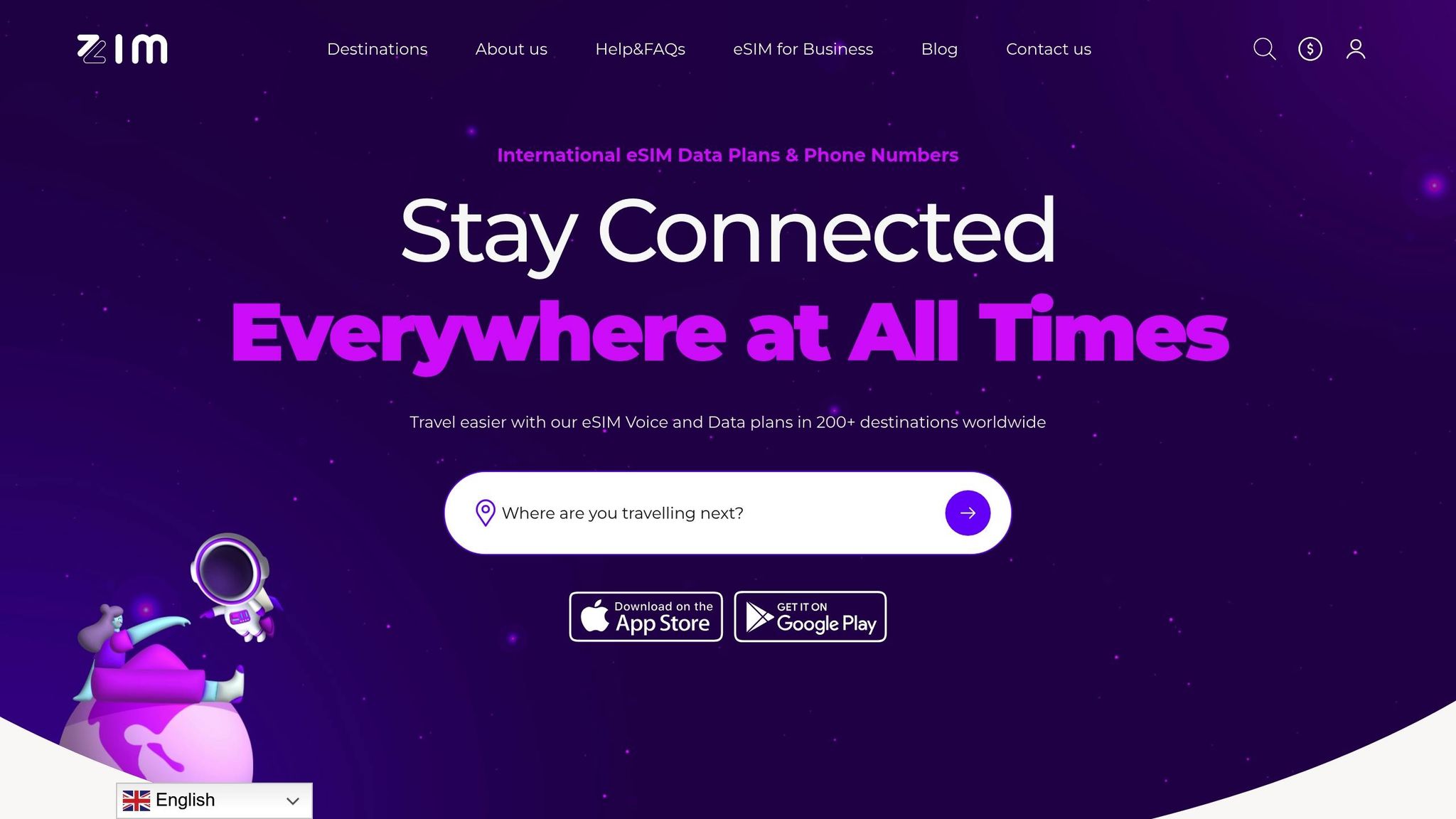
ZIM Connections makes navigating eSIM activation and management even easier. They offer instant digital delivery of QR codes and app-based activation, so you can set up your eSIM before you even leave the UK. Their plans cover a wide range of options, including local, regional, and global eSIM plans with 5G/4G data across more than 200 destinations. Whether you’re Interrailing through Europe or hopping continents, ZIM’s regional and global plans allow you to stick with a single eSIM profile, eliminating the need to install a new one in each country. This simplifies configuration and is especially helpful for travellers who aren’t very tech-savvy.
All ZIM plans are prepaid, letting you manage your spending in pounds sterling and avoid unexpected roaming charges. With options for unlimited data and even local phone numbers, ZIM Connections aligns with the growing trend of hassle-free, cost-conscious international connectivity.
How to Activate eSIM By QR Code on iPhone & Tips for Traveling ( Android tips too! )
Conclusion
eSIM technology has moved from being a niche option to a mainstream solution for travel connectivity. By 2025, 19% of global travellers are expected to use eSIMs, rising to 26% for those visiting multiple destinations. With over 633 million eSIM-enabled devices projected to ship by 2026, the shift is clear. Additionally, more than 300 mobile operators worldwide now support eSIMs, making activation quick and easy in most popular travel destinations.
Travellers are increasingly pre-activating their eSIMs before departure, ensuring they have instant connectivity upon arrival. This is especially common for trips to regions with advanced digital infrastructure like Europe and Asia. Business travellers and digital nomads, in particular, benefit from the ability to maintain multiple profiles for easy switching. The appeal lies in the advantages: savings of 70–90% compared to traditional roaming, activation in under a minute, and the ability to use one profile across multiple countries – all aligning perfectly with the needs of modern travellers.
Challenges such as limited device compatibility and varying operator support are becoming less significant as more smartphones adopt eSIM technology and users become more familiar with it. For UK travellers, preparation is key. Download and install your eSIM profile using a stable home Wi-Fi connection before departure, test it to ensure it’s working, and monitor your data usage while abroad. For those visiting multiple countries, opting for a regional or global plan can save time and effort at borders.
ZIM Connections offers a streamlined solution for modern travellers with prepaid eSIM plans covering over 200 destinations. With 5G/4G connectivity and digital activation in pounds sterling, it’s a convenient option for UK travellers. As multi-eSIM devices and AI-driven network switching become more common, eSIMs are set to become a travel essential, much like travel insurance or digital payments. Embracing eSIM technology today ensures a smoother travel experience tomorrow.
FAQs
How can eSIMs help travellers save money compared to traditional roaming?
eSIMs offer a smart way for travellers to cut down on costs by doing away with pricey international roaming fees. Rather than sticking to traditional roaming options, you can activate prepaid plans designed for specific countries or regions, giving you more control over your budget.
With eSIMs, you get access to fixed-rate data and voice plans, meaning no surprise charges creeping up on you. It’s a practical choice for staying connected while travelling without overspending.
What challenges are slowing the adoption of eSIMs among travellers?
Several challenges are slowing down the adoption of eSIMs among travellers. One major hurdle is device compatibility – many smartphones and devices still don’t support eSIM technology, limiting its accessibility. On top of that, lack of awareness plays a significant role. For many travellers, traditional SIM cards remain the go-to option simply because they’re more familiar.
Another concern revolves around data security. Some users worry about how safe their personal information is during the eSIM activation process. Finally, the setup process can feel intimidating or overly complicated, especially for those who aren’t particularly tech-savvy. Overcoming these obstacles is crucial to making eSIM technology a more practical and appealing choice for international travellers.
How can travellers check if their devices support eSIM before going abroad?
To determine if your device supports eSIM, start by checking the manufacturer’s specifications or exploring the settings menu for any eSIM-related options. Make sure your device is unlocked, supports eSIM functionality, and has the latest software updates installed. Additionally, confirm with your mobile provider that your device is compatible with their eSIM services, especially if you’re planning to use it while travelling.