




eSIM API Integration with Payment Gateways
https://www.zimconnections.com/esim-api-integration-with-payment-gateways/
 SHARE
SHARE
Want to activate mobile connectivity instantly after payment? eSIM API integration with payment gateways makes it possible. Here’s how it works:
- Instant Activation: When a payment is confirmed, the eSIM API automatically provisions a profile, allocates data, and sends a QR code or link for installation.
- Automation: Payment gateways trigger actions like eSIM activation through webhooks (e.g., Stripe‘s
payment_intent.succeededevent). - Global Reach: eSIM APIs connect to networks in 190+ countries, enabling worldwide mobile services without managing multiple carrier agreements.
- Security & Compliance: Payment gateways ensure secure transactions, while eSIM platforms adhere to UK regulations like GDPR and PCI DSS.
This integration eliminates manual steps, reduces delays, and supports high transaction volumes. Whether you’re a business or a traveller, it simplifies access to mobile services while maintaining security and reliability.
eSIM top up using the API example – eSIM Access
Prerequisites for Integration
Before diving into the integration of eSIM APIs with payment gateways, it’s essential to lay a solid technical and security foundation. This involves obtaining the necessary credentials, preparing your infrastructure, and ensuring compliance with UK regulations. These steps are the backbone of a smooth and secure integration process.
Setting Up eSIM Platform API Access
Start by registering for a management dashboard. This tool lets you manage your eSIM setup, monitor real-time activity, and create API keys. These keys are critical for enabling automated, real-time plan customisation. Authentication typically uses API keys or OAuth2 HTTP bearer tokens, which are available through the platform’s developer portal. You’ll receive two sets of credentials: one for testing in a sandbox environment and another for live production use. Keep these credentials secure and confidential.
Your backend infrastructure should be capable of securely handling API requests and responses, as well as storing transaction data like payment IDs and eSIM statuses. All communication with APIs must occur over HTTPS in production environments, though HTTP may be permissible during testing. Additionally, configure webhook endpoints to receive event notifications, and ensure you have a persistent datastore for mapping user sessions to platform-specific identifiers (e.g., paymentId or eSIM_ID).
"Thanks to the simple and standard API of eSIM Go, and our highly flexible and scalable platform, we completed the integration and testing within just two days." – Itamar Bareket, CTO, MobiMatter
Once your API access is established, the next step is to set up your payment gateway account.
Configuring Payment Gateway Accounts
To begin, create an account with your chosen payment gateway and generate both test and live API keys. Test keys are essential for validating your integration without processing real transactions, while live keys handle actual payments when you’re ready to go live. Configure webhook endpoints to receive updates on transaction statuses, such as payment_intent.succeeded or payment_intent.payment_failed, which can trigger automated actions in your eSIM provisioning system.
Through the payment gateway’s dashboard, enable the payment methods you wish to support – like credit cards, Apple Pay, or Google Pay – and customise the look of hosted payment elements to match your brand. Always use HTTPS for return URLs, and avoid including sensitive information in redirect parameters.
Be mindful of the provider’s rate limits; for instance, GOV.UK Pay allows up to 15 POST requests per second. To handle rate limit errors (HTTP 429), implement an exponential backoff strategy. Also, store webhook secrets securely to ensure that notifications are authentic.
Compliance and Security Considerations
When integrating eSIM and payment services in the UK, compliance with multiple regulatory frameworks is mandatory. The UK GDPR and the Data Protection Act 2018 require measures like pseudonymisation and data minimisation to protect personal data. For card payments, adherence to PCI DSS v4.0.1 is compulsory, as this standard becomes effective from January 2025.
Strong Customer Authentication (SCA) requirements, as outlined in the UK-onshored SCA-RTS, mandate the use of at least two independent factors for account access or electronic payments. For eSIM services, the Telecommunications (Security) Act 2021 and PSTI Act 2022 impose additional security measures, such as banning default passwords and implementing public vulnerability disclosure policies. It’s also crucial to confirm that your eSIM provider holds GSMA SAS accreditation for secure data generation and subscription management.
To further enhance security, implement IMEI locking and SIM policies to prevent misuse of stolen eSIMs. Use private APNs and private IPs to keep eSIM devices off public networks, and restrict access to sensitive endpoints through VPN-only connections.
Step-by-Step Integration Guide
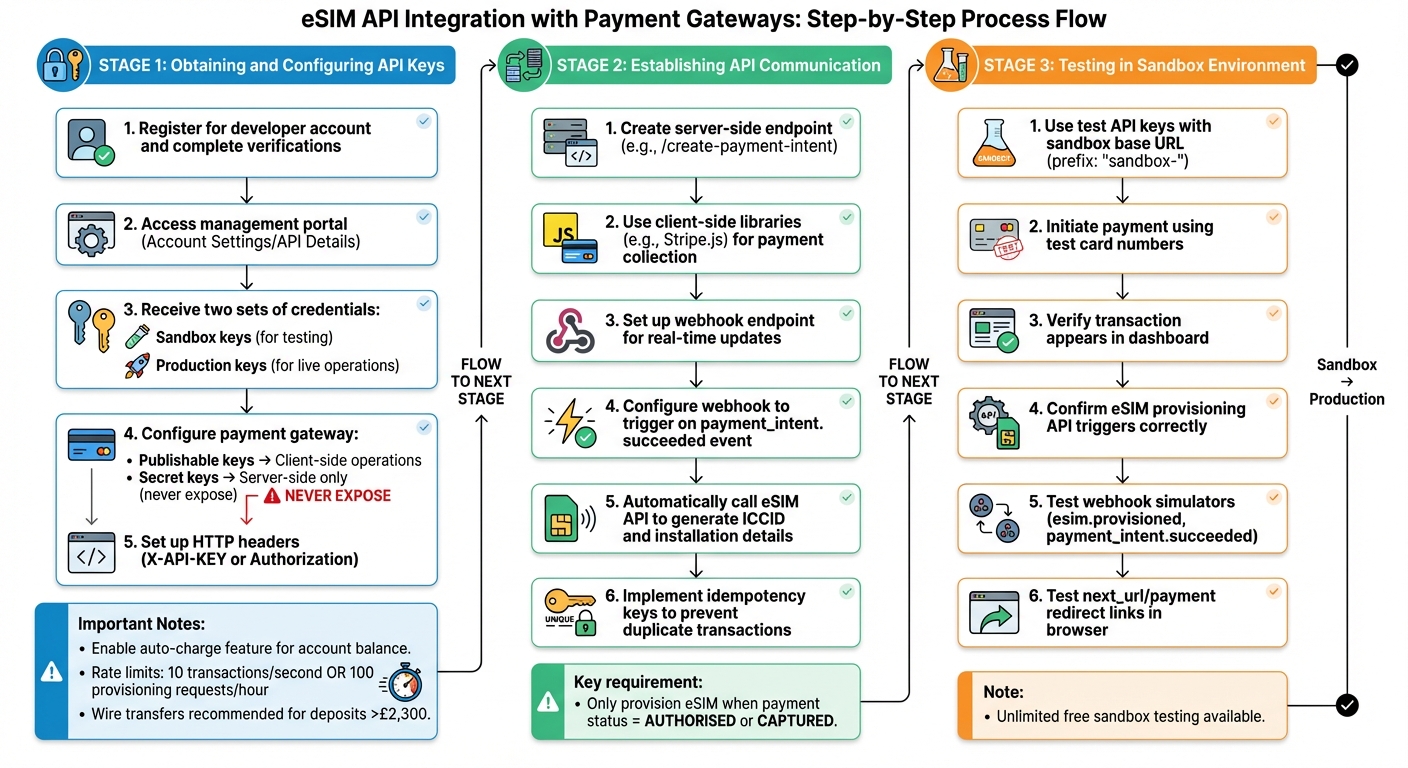
eSIM API Integration with Payment Gateways: Complete Implementation Process
Once you’ve got everything ready, it’s time to integrate your eSIM platform with your payment gateway. This involves getting the necessary credentials, setting up secure communication, and running tests to ensure everything works smoothly before handling real transactions.
Obtaining and Configuring API Keys
Start by registering for a developer account and completing any required verifications. Once you’re set up, head to your management portal – usually under sections like "Account Settings" or "API Details" – to find your API credentials. You’ll typically receive two sets of keys: sandbox keys for testing and production keys for live operations.
Since most eSIM platforms follow a pre-paid model, you’ll need to keep an account balance to provision eSIMs. To avoid interruptions, enable the "auto-charge" feature in your portal, which automatically tops up your balance when it falls below a certain level. If you’re depositing more than £2,300, wire transfers are a better option than online payments for smoother processing.
When setting up your payment gateway, generate both test and live API keys. Use publishable keys for client-side operations and keep secret keys strictly for server-side processes. Store these secret keys securely on your server – never expose them in client-side code. Think of your API key or token as a password; it’s crucial to keep it private.
For proper communication, configure the HTTP headers required by your eSIM platform. This might involve using a custom header like "X-API-KEY" or an "Authorization" header. Be mindful of rate limits – some platforms allow only 10 transactions per second, while others may limit you to 100 provisioning requests per hour and 1,000 status checks per hour.
With these API keys ready, you can now set up your server for secure communication.
Establishing API Communication
Use the API keys you’ve configured to authenticate your server endpoint. Create a server-side endpoint (e.g., /create-payment-intent) to securely manage the payment lifecycle. This ensures that payment amounts are calculated server-side, reducing the risk of client-side tampering. For collecting payment details, use client-side libraries like Stripe.js, which keep sensitive card data off your server and help maintain PCI compliance.
The best way to ensure smooth integration is by using webhooks for asynchronous communication. Set up a webhook endpoint to receive real-time updates from the payment gateway, such as payment_intent.succeeded. When this event triggers, your system should automatically call the eSIM API to generate the ICCID and installation details. Webhooks are more reliable than client-side callbacks, which can be disrupted or manipulated.
To avoid duplicate transactions, implement idempotency keys. Make sure eSIM provisioning only happens once the payment status is either AUTHORISED or CAPTURED.
Testing in a Sandbox Environment
Before going live, test everything in a sandbox environment to ensure your integration works as expected. Sandbox environments simulate real-world behaviour without affecting actual transactions or funds. Use your test API keys and connect to the sandbox base URL – these keys often have unique prefixes like "sandbox-" to prevent accidental live transactions. Most platforms provide unlimited sandbox testing for free.
Test the entire flow: initiate a payment using the test card numbers provided by your payment gateway, confirm the transaction appears in your dashboard, and verify that the eSIM provisioning API is triggered correctly. Use webhook simulators to check that your system processes notifications like esim.provisioned or payment_intent.succeeded as intended.
Finally, test any next_url or payment redirect links included in the API response. Open these links in a browser to experience the customer-facing payment process and ensure everything looks and works as it should.
sbb-itb-273ea09
Security and Data Protection
Once your integration is operational, protecting payment transactions and securing eSIM data requires strong encryption, strict authentication protocols, and adherence to relevant compliance standards.
Implementing Encryption and Tokenisation
To protect sensitive data, all payment information transmitted between your server, the payment gateway, and the user must be encrypted using TLS. Beyond securing data in transit, ensure payment tokens are managed securely once they reach your server.
For transmitting payment method tokens, use the Elliptic Curve Integrated Encryption Scheme (ECIES). Decrypt payloads using established standards like AES-256, HMAC-SHA256, and ECDSA to confirm data integrity and authenticity.
Stick to trusted cryptographic libraries, such as Google Tink, rather than writing custom encryption code. Rotate encryption keys regularly – preferably once a year – and ensure your system can decrypt using both old and new keys during the transition. Periodically refresh root signing keys to minimise delays, and always validate the messageExpiration and keyExpiration fields in decrypted payloads to reject expired keys or transactions.
Replace card numbers with PaymentMethodTokens to reduce risk. These tokens may include details like a device PAN and a 3-D Secure cryptogram, which can simplify PCI DSS compliance. Similarly, eSIM profiles are safeguarded at the hardware level, as they are embedded in devices and cannot be easily removed, reducing the likelihood of SIM card fraud.
Authentication and Authorisation
Encryption is just the first step – ensuring that only authorised users and systems can access secured APIs is equally critical. Validate API keys for every request, and for user-facing authentication, implement multi-factor authentication methods such as SMS-based OTPs, biometrics, or web logins.
For returning users, use secure cookie-based sessions to maintain identification without exposing sensitive data in URLs. Avoid referencing sensitive information like transaction numbers directly in URL paths (e.g., /payment_12345). To prevent duplicate transaction processing, include a unique requestId in the request header to ensure idempotency.
Adhering to Compliance Standards
Encryption and authentication measures are bolstered by compliance with standards like PCI DSS and GDPR, which protect both your business and your customers. Using a Payment Service Provider (PSP), such as GOV.UK Pay, can simplify compliance by ensuring raw card data never touches your servers, thereby reducing your PCI DSS obligations.
For GDPR compliance, avoid embedding personal information or reference numbers in URLs. Instead, store only essential metadata – such as a unique ID, the requested service, the PSP’s paymentId, payment status, and the transaction start time. Implement an automatic reconciliation process (sometimes called a "mop-up job") to periodically check and resolve incomplete payment journeys.
| Compliance Measure | Implementation Method | Purpose |
|---|---|---|
| PCI DSS Scope Reduction | Redirect users to a PSP-hosted page | Prevents storing or processing raw card data on your servers |
| Data Protection (GDPR) | Encrypted sessions and clean URLs | Avoids exposing personal data in browser history or server logs |
| Transport Security | Mandatory HTTPS | Safeguards data in transit between users, your platform, and the gateway |
| Transaction Integrity | Background reconciliation | Ensures payments are reconciled even if users abandon their transactions |
Before moving to production, thoroughly test your compliance and data flow processes in a sandbox environment. If you collect billing addresses, consider using the payment gateway API to pre-fill payment fields, which can improve the user experience while maintaining data accuracy. By integrating these measures, you can create a secure and seamless eSIM activation process, enhancing both system reliability and customer confidence.
Deployment, Monitoring, and Scaling
Transitioning to Production
After completing sandbox testing, move to live operations by swapping test API keys with production credentials. Remember, live keys work exclusively in production, so double-check your system’s setup before making the switch. To safeguard customer data, production environments must use HTTPS for all communications.
It’s crucial to calculate order totals on the server side before initiating payment requests. This step prevents users from tampering with prices through client-side code. Additionally, implement an automated process to handle incomplete payment journeys caused by abandoned sessions. GOV.UK Pay suggests ignoring transactions from the past three hours to avoid disrupting payments still being processed.
Before going live, ensure your backend system accurately records key transaction details, including the primary key, service requested, gateway payment ID, status, and start time.
Monitoring Transactions and User Activity
Once your system is live, monitoring becomes critical to maintaining smooth operations. Webhooks are a reliable way to get real-time updates on payment statuses, outperforming repeated API polling, which can lead to rate limit issues at scale. Set up your backend to automatically execute actions – like provisioning eSIM profiles or sending confirmation emails – immediately after receiving a payment_intent.succeeded event. For payment methods with delayed notifications, such as bank transfers, mark orders as pending until a webhook confirms success.
Payment gateway dashboards are invaluable for tracking transaction volumes, settlement times, refunds, and disputes. Use APIs to retrieve detailed event histories for individual payments, helping you audit user journeys and pinpoint drop-offs. Keep an eye on specific error codes, like P0020 for expired payments, to spot recurring issues in your checkout process. Also, note that users often have a limited window to complete payments; for instance, GOV.UK Pay sessions expire after 90 minutes.
Scaling to Meet Demand
As transaction volumes grow, solid monitoring practices are essential for maintaining performance. Secure communication practices, idempotency, and robust logging are key to handling high-volume processing. Asynchronous webhook handling ensures your system remains in sync, even during network disruptions or frontend crashes. Use unique idempotency keys to prevent duplicate transactions during retries or traffic spikes. Payment platforms typically offer 99.999% uptime, ensuring the reliability needed for scaling.
To simplify global operations, consider using a single payment API that supports multiple currencies and local payment methods, like iDEAL or Alipay, instead of integrating separate processors for each region. For eSIM services with recurring plans, subscription billing APIs can automate renewals, manage failed payments (dunning), and handle usage-based billing. With cross-border transactions expected to make up 33% of global e-commerce spending by 2028, having scalable infrastructure is increasingly important.
Log all API requests, webhook payloads, and error responses – ensuring sensitive data is scrubbed – and set up real-time alerts for failed payments, webhook errors, and high decline rates. Test high-volume scenarios in the sandbox, such as card declines, expired cards, and fraud flags, to prepare your system for live conditions. Also, keep SDKs and API versions up to date, as outdated libraries can lead to fragile code that breaks when providers make updates.
These practices ensure a smooth transition from deployment to scaling, completing the integration cycle outlined earlier.
Conclusion
Integrating eSIM APIs with payment gateways transforms how businesses and travellers access connectivity. From setting up API credentials to deploying webhooks for instant fulfilment, the entire process becomes automated – managing everything from authorisation to eSIM delivery without requiring manual input. Using encryption and tokenisation provided by gateways also ensures PCI DSS compliance while allowing full control over branding and plan customisation.
This streamlined approach offers clear benefits. With the global in-app purchase market expected to hit around £225.37 billion by 2025, the infrastructure you’ve built is well-positioned to grow alongside this trend. For travellers, the perks include support for local payment methods, instant QR code delivery after payment, and a smooth checkout experience that fosters trust and reduces cart abandonment.
Reliable integration ensures the system can handle high transaction volumes with 99.999% uptime. Features like idempotency keys and webhook-driven fulfilment safeguard against duplicate charges and ensure eSIMs are delivered even during network issues.
FAQs
How does integrating eSIM APIs improve payment security?
Integrating eSIM APIs enhances payment security by enabling secure authentication methods and limiting access to sensitive transaction details. This approach reduces the likelihood of fraud and unauthorised transactions, delivering a safer and more dependable payment process.
With eSIM technology, businesses gain better control over verifying user identities and authorising payments. This added layer of security helps build a strong barrier against potential threats.
What compliance requirements should you consider when integrating eSIM platforms with payment gateways in the UK?
When connecting eSIM platforms with payment gateways in the UK, meeting compliance standards is a must for secure and lawful transactions. This involves following the Payment Card Industry Data Security Standard (PCI DSS), which ensures safe handling of payment data. It’s also vital to implement strong API authentication practices, such as securely managing API keys and encrypting data during transmission.
On top of that, adhering to anti-money laundering (AML) and know your customer (KYC) regulations is key when dealing with financial transactions. These protocols not only protect user data but also uphold transaction integrity, keeping everything in line with UK financial and data protection laws. By focusing on these requirements, businesses can provide users with a secure and smooth experience in the UK.
How can businesses simplify global eSIM connectivity without dealing with multiple carrier contracts?
Businesses can streamline global eSIM connectivity by using eSIM API solutions that bring together telecom services from multiple networks around the world. These APIs allow for centralised control of eSIMs, data plans, and transactions, removing the hassle of managing separate agreements with individual carriers.
Key features like real-time activation and automatic network switching enable companies to offer smooth eSIM plans – whether for local, regional, or global use. This not only simplifies administrative tasks but also ensures dependable connectivity in over 200 destinations. With these tools, businesses can deliver a consistent experience to users while managing everything through a single, unified platform.