




How Urban and Rural 5G Coverage Impacts Travellers
https://www.zimconnections.com/how-urban-and-rural-5g-coverage-impacts-travellers/
 SHARE
SHARE
Travelling with 5G? Here’s the reality:
- Cities thrive on 5G. Urban areas like London and Manchester offer fast speeds (200+ Mbps), low latency, and reliable connections for smooth navigation, video calls, and uploads.
- Rural gaps exist. In the countryside – think the Scottish Highlands or rural Wales – coverage drops, with many areas relying on slower 4G or even 3G. Speeds can range from 72 to 245 Mbps, and latency spikes make tasks like live navigation or HD video calls difficult.
- Battery drains faster. Constant switching between networks (5G, 4G, 3G) in mixed-coverage zones can quickly deplete your phone’s battery.
- Preparation is key. Check coverage maps, use eSIMs for better connectivity, and download maps or media beforehand to avoid disruptions.
Bottom line: Plan ahead to stay connected, especially if your trip takes you beyond city limits.
How to Check 5G Coverage in Your Area? #shorts
How 5G Coverage Differs Between Urban and Rural Areas
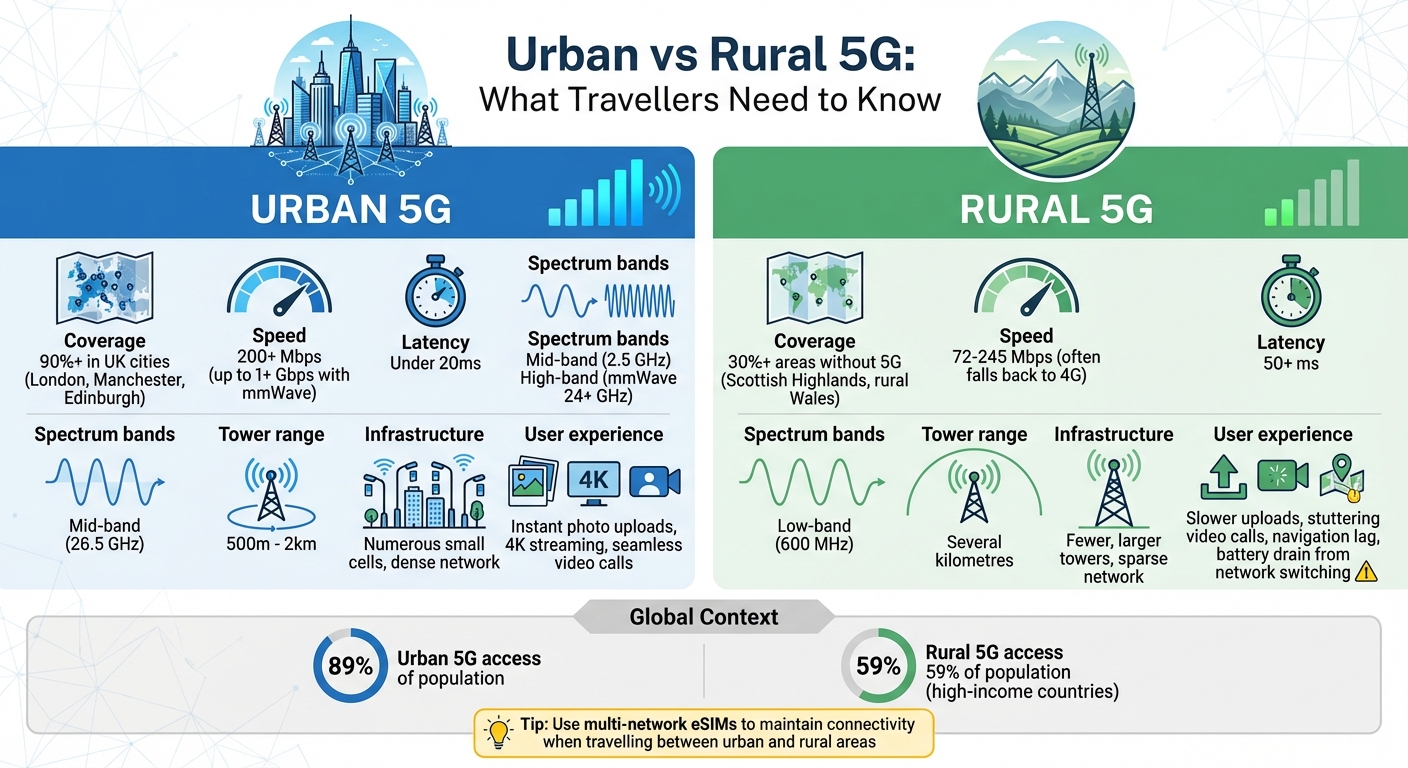
Urban vs Rural 5G Coverage: Speed, Latency and Access Comparison for Travellers
How 5G Networks Are Built
5G operates across three spectrum bands, each with distinct characteristics. The low-band spectrum (like 600 MHz) covers vast areas – reaching several kilometres per tower – but offers slower speeds, typically ranging from 50 to 250 Mbps. The mid-band spectrum (around 2.5 GHz) strikes a balance, covering 1–2 km while delivering speeds between 200 and 500 Mbps. The high-band spectrum (mmWave, over 24 GHz) provides ultra-fast speeds exceeding 1 Gbps but is limited to about 500 metres and struggles to penetrate buildings effectively.
In urban areas, 5G networks rely heavily on mid- and high-band spectrums, supported by numerous small cells to enhance indoor coverage and manage high user demand. Conversely, rural areas depend more on low-band spectrum, with fewer and larger towers. This approach prioritises wider coverage over speed, reflecting the lower population density and the higher costs of rural infrastructure.
Coverage Gaps Between Cities and Rural Areas
The difference in network design leads to noticeable coverage gaps between urban and rural regions. In countries like the UK, urban areas enjoy extensive 5G access, with coverage exceeding 90%. However, many rural areas are still reliant on low-band networks, leaving over 30% of some regions without any 5G service.
For example, cities like London benefit from over 90% 5G coverage, supported by mid- and high-band networks provided by operators such as EE and Vodafone. In contrast, rural areas, including parts of the Scottish Highlands and Wales, often rely on low-band spectrum. As of 2025, more than 30% of these rural regions remain uncovered. The limited range of 5G signals compared to 4G requires more towers to achieve similar coverage, but economic constraints often hinder such investments in sparsely populated areas.
How Coverage Differences Affect Your Connection
These coverage gaps have a direct impact on the user experience. Travelling between urban and rural areas often reveals stark differences in network performance. In cities, robust 5G networks deliver speeds above 200 Mbps with latencies under 20 milliseconds, enabling seamless streaming and rapid uploads. In rural areas, speeds can drop to between 72 and 245 Mbps, latency may exceed 50 milliseconds, and devices often switch back to 4G.
The practical effects are clear. In urban settings, uploading photos happens almost instantly, and 4K video streams without interruptions. In rural areas, however, the same tasks can take significantly longer. Video calls may stutter, navigation apps might lag, and frequent network switching can drain your device’s battery. While city dwellers enjoy consistently high speeds and low latency, rural users face slower connections and less reliable service, which can disrupt everyday tasks.
What Urban and Rural 5G Coverage Means for Travellers
How Different Travel Types Are Affected
Travellers experience vastly different connectivity depending on where their journeys take them. For those on city breaks or business trips, urban 5G is a game-changer. In major UK cities like London, Manchester, and Edinburgh, speeds often exceed 200 Mbps, offering ultra-responsive connections. This means quick uploads, crystal-clear calls, and seamless access to cloud-based tools. Business travellers, in particular, benefit from this reliability, whether they’re transferring large files or joining hybrid meetings from hotels or co-working spaces. Services like ZIM Connections offer 5G/4G eSIM plans that keep you connected the moment you arrive.
However, road trips, train journeys, and visits to remote areas tell a different story. As you leave urban hubs, connectivity can dip significantly. Speeds typically range between 72 and 245 Mbps in suburban and rural areas, and devices often default to 4G. In rural regions, 5G coverage relies on low-band spectrum. While this offers wider reach, speeds are more modest. In very remote locations – think national parks, the Scottish Highlands, or coastal Wales – connections may fall back to 3G or even 2G, which can disrupt real-time navigation, live traffic updates, or cloud-reliant apps. Using a regional or global eSIM that switches between networks can help maintain a steady connection as you move through these diverse coverage zones.
Globally, about 89% of urban populations have 5G access, compared to just 59% in rural areas of high-income countries. For UK and European travellers, this generally means near-complete 5G coverage in cities and transport hubs, but a heavier reliance on 4G in rural settings. These disparities directly affect which tasks can be performed smoothly.
Tasks That Struggle with Poor Rural Coverage
In areas with weaker networks, certain activities become noticeably harder. High-definition video calls, cloud gaming, and uploading large files are particularly affected. Rural networks often struggle with reduced throughput, higher jitter, and packet loss, leading to frozen video, dropped audio, or failed uploads. Even if download speeds seem acceptable, slower upload speeds can make sharing high-resolution photos or videos frustrating.
On the other hand, less demanding tasks like text messaging (via WhatsApp or SMS), basic email, or checking maps (if areas are pre-downloaded) are more manageable on 4G or even 3G. While pages may take longer to load, essential tasks like timetable checks, simple web browsing, and standard-quality music streaming often work fine. Many apps adjust automatically by lowering video quality or switching to audio-only modes. To minimise issues, downloading offline maps, boarding passes, and key documents while connected to strong urban 5G can reduce your reliance on constant connectivity in rural areas.
Battery Drain from Network Switching
Frequent changes in network signals can drain your phone’s battery faster than usual. As you move through areas with inconsistent coverage, your device constantly scans for and switches between 5G, 4G, and 3G networks. This process increases power consumption and can leave your phone feeling warm and draining quickly. This is especially noticeable on fast-moving trains or long drives through rural areas.
To tackle this, many roaming profiles prioritise connection stability over peak speed. In areas where 5G is unreliable, your phone may automatically stick to 4G to avoid call drops and data interruptions. Additionally, eSIM platforms often support automatic network selection, allowing your device to switch seamlessly between partner networks without requiring a physical SIM swap. This not only simplifies connectivity but also helps manage battery life more effectively.
sbb-itb-273ea09
Preparing for Travel Across Urban and Rural Areas
Checking Coverage Before You Travel
Before heading out on a trip that takes you through both cities and the countryside, it’s a good idea to check your mobile network’s coverage maps. Most UK networks, like EE, O2, Vodafone, and Three, provide interactive maps that show the availability of 5G, 4G, and 3G services, often down to specific roads. Pay close attention to the map’s legend, which usually highlights zones for 5G, 4G, and areas where coverage is limited to outdoor use. Keep in mind that even if an area appears covered, indoor signals – especially in rural buildings with thick walls – might be weaker.
For longer journeys, it’s wise to plan your route to avoid areas likely to have 3G dead zones. If you’re staying overnight, check the indoor coverage at your accommodation beforehand. Travelling abroad? Apply the same approach with local network operators or your roaming/eSIM provider. Reviewing international coverage details can help you anticipate any connectivity gaps.
Independent performance data, such as Ookla Speedtest reports, can provide a more realistic picture of network availability. While a map might label an area as "5G-covered", the actual performance can vary based on the spectrum band. For instance, low-band 5G, common in rural areas, offers wider coverage but at slower speeds. In contrast, mid-band or high-band 5G, typically found in cities, delivers faster speeds but over shorter distances.
Once you’ve mapped out your route and assessed coverage, the next step is to choose an eSIM plan that can handle these mixed conditions.
Selecting the Right eSIM and Data Plan
For trips that take you across both urban and remote areas, it’s best to choose an eSIM plan that works across multiple networks. This increases the likelihood of maintaining strong 4G or low-band 5G connectivity in rural areas where a single operator might struggle. Look for plans that include both 4G and 5G, as 4G often remains the most reliable option in less densely populated regions.
Regional or global eSIM plans are especially handy for multi-destination travel. They eliminate the hassle of swapping SIM cards repeatedly and ensure you stay connected, even on remote routes. Providers like ZIM Connections offer a range of eSIM options – local, regional, and global – covering over 200 destinations. These plans typically include 5G/4G data and often offer unlimited data options, so you can enjoy faster speeds in cities while relying on dependable 4G in rural areas where 5G might be scarce.
When choosing a plan, check for fair-use policies, hotspot allowances, and roaming limits. These features ensure your navigation, messaging, and work apps keep running smoothly, even if speeds dip in the countryside. With plans starting from as little as £2, you can avoid hefty roaming fees and even enable hotspot sharing for your laptop or tablet. This way, you can stay connected whether you’re in the heart of a city or deep in the countryside.
Setting Up Your Device for Better Connectivity
Once you’ve chosen the right eSIM, take some time to optimise your device settings to handle varying coverage conditions. Set your phone to "5G Auto" mode to prioritise 5G in cities while switching to 4G in areas with weaker signals. If you’re in a location with particularly unreliable 5G, manually selecting 4G/LTE can help conserve battery life and stabilise your connection for calls and messaging.
For those using dual-SIM devices, keep your UK physical SIM active for calls, texts, and essential services, while using your eSIM for data and local 4G/5G connectivity. On most modern smartphones, you can set the eSIM as your default data line and disable data on your UK SIM to avoid costly roaming charges. This setup still allows you to receive calls and texts on your UK number. Enabling automatic network selection will help your eSIM connect to the best available network as you move between urban and rural areas. In particularly remote locations, you might need to switch to whichever SIM offers the strongest signal.
To stay reachable in areas with poor mobile coverage but strong Wi-Fi, enable Wi-Fi calling. Additionally, use battery-saving modes and restrict background data for non-essential apps to minimise the impact of fluctuating signal strength. For long rural stretches, consider downloading offline maps, saving digital tickets, and backing up booking confirmations to reduce your reliance on a constant internet connection.
Managing Connectivity Whilst Travelling
Timing Your Data Usage
Make the most of strong 5G or Wi-Fi connections by planning data-heavy activities during these times. Many hotels, cafés, and train stations provide free or inexpensive Wi-Fi – use these opportunities to sync cloud storage, download streaming content, and update maps before heading into areas with weaker connectivity.
To avoid unexpected data usage when coverage is unreliable, schedule updates to run only when connected to Wi-Fi. Set automatic backups to happen overnight while you’re on a stable connection, and reserve mobile data for essentials like messaging and navigation when travelling through rural areas. Pre-download films, playlists, and offline courses before leaving urban zones to ensure you’re not left stranded by patchy 4G or non-existent 5G. This kind of preparation not only helps conserve data but also supports safer connectivity practices, which we’ll explore next.
Staying Safe in Areas with Poor Coverage
Before venturing into remote or mountainous regions, it’s wise to share your travel itinerary and expected arrival times with a trusted contact. Arrange check-ins via SMS or messaging for when you’re back in coverage, so someone can take action if you don’t arrive as planned.
Save offline maps and key contact details, such as accommodation addresses, local emergency numbers (999 or 112 in the UK), booking confirmations, and other important information. Keep in mind that even if your phone lacks network signal, emergency calls can often connect using any available network. However, in areas with no mobile signal at all, emergency calls may not work. For activities like hiking or cycling in very remote locations, consider carrying a satellite messenger or personal locator beacon for added safety. A fully charged power bank and using battery-saver mode on your phone can ensure you stay connected and ready to make emergency calls after a long day without access to mains power.
Fixing Common Connectivity Problems
Even with careful planning, connectivity issues can crop up. If your signal drops while travelling, try toggling aeroplane mode on and off to prompt a network search. If that doesn’t help, disable automatic network selection and manually choose a stronger network – this is particularly useful when using an eSIM with multiple partner networks. Restarting your device can also resolve registration glitches, and if problems persist, resetting your network settings (note: this will erase saved Wi-Fi networks and Bluetooth pairings) may solve the issue.
In areas where 5G is unreliable, switching to 4G/LTE in your settings can provide a steadier connection and reduce battery drain caused by constant network searching. If you’re staying in a rural hotel or cottage with poor signal, try moving closer to windows, heading to higher floors, or using Wi-Fi calling if the broadband connection is stable. For those frequently crossing borders or travelling between urban and rural areas, ZIM Connections offers eSIM plans that work with partner networks in over 200 destinations. These plans allow your device to switch between local carriers, improving the chances of finding a strong signal in rural areas where a single provider might fall short.
Conclusion
The disparity in 5G coverage between urban and rural areas remains a pressing issue. In wealthier nations, about 89% of urban residents have access to 5G, compared to just 59% of rural populations. For travellers, this means you can enjoy fast, dependable connections in major cities, but once you head into remote areas – whether it’s the Scottish Highlands or charming European villages – you might encounter spotty service, slower speeds, or even a fallback to 4G or 3G.
These gaps can significantly impact your travel experience. Activities that are effortless in a city, like HD video calls, live navigation, or ride-hailing, might become unreliable in rural areas. Even your device could struggle, draining its battery faster as it searches for a stable signal.
To navigate these challenges, preparation is key. Check coverage maps before your trip, download maps or entertainment for offline use, and treat connectivity as an essential part of your travel planning. Most importantly, opt for a reliable eSIM provider that connects you to multiple local networks and offers a strong 4G backup when 5G isn’t available. With these steps, you’ll stay connected and ready, no matter where your journey takes you.
FAQs
How can I stay connected to 5G when travelling in rural areas?
Staying connected to 5G in rural areas can be tricky, but there are ways to enhance your experience. One option is to use an international eSIM plan, like those from ZIM Connections, which offer dependable 5G/4G coverage in over 200 locations, including remote areas. Their plans include features like unlimited data and local phone numbers, making it easier to stay connected no matter where you are.
To get the most out of your connection, make sure your device is 5G-compatible and choose a plan that suits your travel needs – whether you’re staying local, covering a region, or travelling globally. You can also boost your signal by staying in open spaces with fewer physical barriers, which can help improve both strength and speed.
How does switching between networks affect my phone’s battery life?
Switching between networks can take a toll on your phone’s battery. This happens because your device works overtime to search for and latch onto available signals. It’s particularly noticeable when moving from urban areas with strong 5G coverage to rural spots where signals can be weaker or patchy.
To help your battery last longer, try enabling your phone’s battery-saving settings. Another smart move is opting for a reliable eSIM plan, which provides steady connectivity across various regions. A stable network connection reduces how often your phone has to hunt for signals, keeping your battery from draining too quickly.
Why is 5G coverage better in cities than in rural areas?
5G coverage is generally more robust in cities compared to rural areas, and there are a few reasons behind this. Urban centres, with their dense populations, attract more investment in network infrastructure. This leads to a higher concentration of 5G towers, ensuring faster and more reliable connections for city dwellers.
In contrast, rural areas face unique challenges. With fewer people spread over larger distances, coupled with tough terrain, building and maintaining the necessary infrastructure becomes more expensive and complicated. As a result, these areas often have patchy coverage, meaning those travelling outside cities might encounter slower speeds or limited connectivity.