




eSIM Compliance vs. Permanent Roaming
https://www.zimconnections.com/esim-compliance-vs-permanent-roaming/
 SHARE
SHARE
eSIM compliance is reshaping global connectivity by offering cost-effective and regulation-friendly alternatives to permanent roaming. While permanent roaming connects devices as "visitors" to foreign networks, eSIM compliance enables direct local connections, reducing costs by up to 95% and ensuring uninterrupted service, even in countries where roaming is restricted or banned.
Key points to consider:
- Cost Difference: eSIM plans often cost a fraction of traditional roaming fees. For example, 2GB of data on eSIM might cost £6–£12 compared to £56–£67 with roaming.
- Regulatory Risk: Permanent roaming faces bans or restrictions in countries like Brazil, Turkey, and China. eSIM compliance adheres to local rules, avoiding penalties or disconnections.
- Network Performance: eSIM ensures local network priority with full-speed 4G/5G access, unlike roaming, which may throttle speeds.
- Long-Term Use: Permanent roaming is capped at ~90 days in many regions, while eSIMs support extended stays without service disruption.
For businesses, eSIM compliance simplifies IoT deployments by meeting local regulations and improving connectivity reliability. Permanent roaming, while convenient for short-term use, struggles with high costs, slower speeds, and regulatory challenges.
Quick Comparison
| Factor | eSIM Compliance | Permanent Roaming |
|---|---|---|
| Cost | Local rates, prepaid plans | Wholesale rates with markups |
| Regulatory Risk | Compliant; no restrictions | High; banned in some countries |
| Network Priority | Local customer access | Lower priority, throttled speeds |
| Duration Limit | Long-term use supported | Typically capped at ~90 days |
eSIM compliance is ideal for frequent travellers, IoT deployments, and anyone seeking a reliable, cost-effective connectivity solution in a world of evolving telecom regulations.
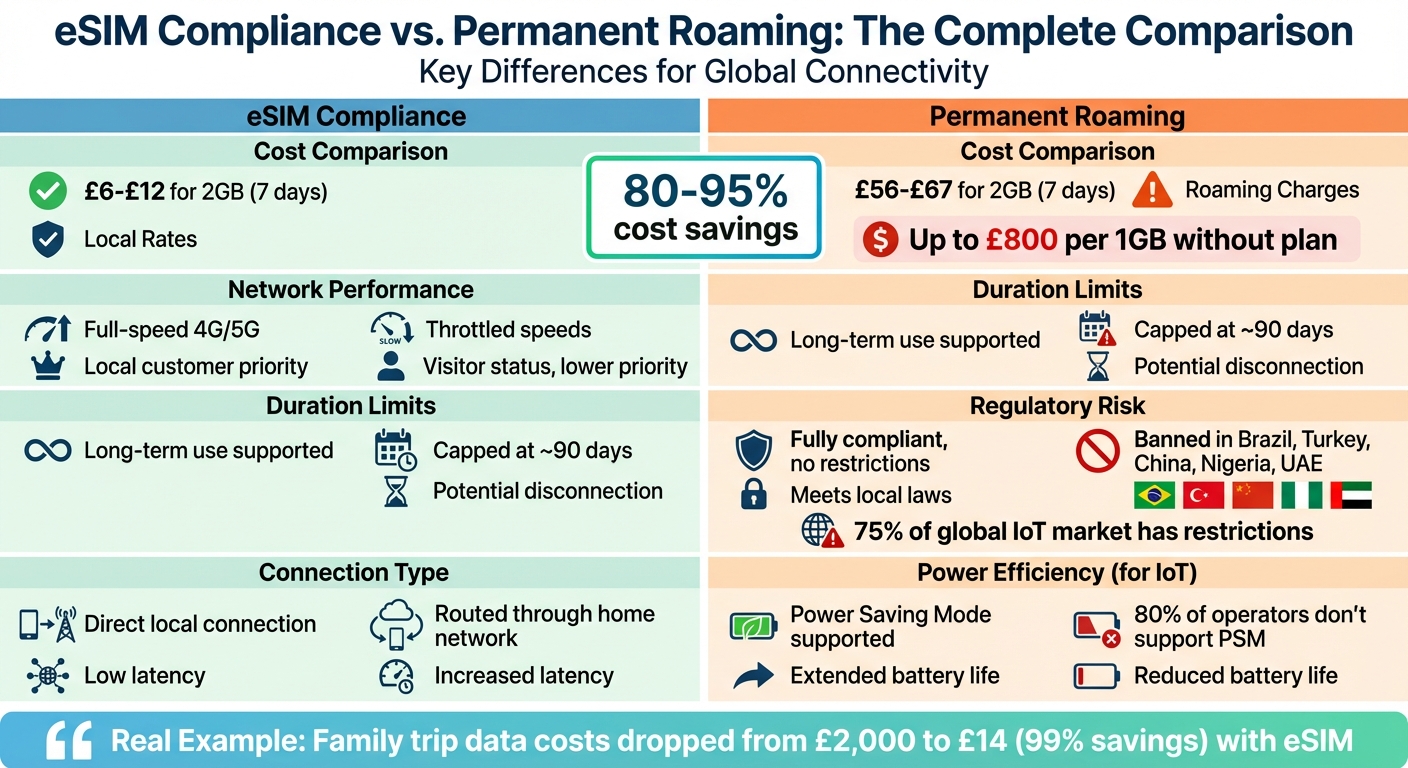
eSIM Compliance vs Permanent Roaming: Cost, Speed, and Regulatory Comparison
What is eSIM Compliance?
Definition and Key Features
eSIM compliance transforms your device from a temporary "visitor" to a local subscriber, bypassing traditional home carrier roaming agreements by adhering to local regulations. It operates within specific regulatory frameworks, such as the EU’s Regulation No 531/2012. This regulation mandates wholesale access and the separate sale of roaming services, ensuring fair competition and transparency.
The regulation highlights its goal:
The envisaged separate sale of roaming services and domestic services should increase competition and therefore lower the prices for customers and create an internal market for roaming services in the Union with no significant differentiation between national and roaming tariffs.
A key distinction with compliant eSIMs is network priority. Unlike traditional roaming, compliant eSIM users enjoy local customer privileges, including full 4G/5G speeds, avoiding the throttling often associated with roaming. Additionally, mobile operators are required to publish a "reference offer" outlining standard conditions for wholesale access, ensuring fair competition. Together, these regulatory and technical measures provide both financial and practical benefits.
Benefits for Global Travellers
For international users, eSIM compliance offers clear advantages. Traditional roaming fees, which can range from £10 to over £50 per day, are significantly reduced with eSIM plans – often by 80%-95%. In some cases, unregulated roaming plans can cost over £1,000 for just 1GB of data.
Aside from cost savings, compliance helps avoid service disruptions. Many countries now limit how long devices can roam, typically capping it at 90 days. Beyond this period, local carriers may block or disconnect roaming devices. Compliant eSIMs ensure uninterrupted service and also guarantee access to emergency services, including caller location transmission, as required by EU Directive 2018/1972. This regulatory framework addresses key issues in the roaming market, empowering consumers with transparent, stand-alone roaming options.
What is Permanent Roaming?
Definition and Characteristics
Permanent roaming occurs when a device remains connected to a foreign network for an extended period, far beyond the typical duration of short-term travel. Unlike the roaming used by holidaymakers or business travellers for a few days or weeks, permanent roaming involves long-term connectivity in a country where the SIM was not originally issued.
This method is often leveraged in global IoT deployments, where devices need seamless connectivity across borders without swapping physical SIM cards. While effective for short-term use, extended connectivity presents challenges. Adam Hayes, COO of Eseye, explains that permanent roaming typically involves a device staying on a non-home network for around three months.
From a technical perspective, permanent roaming has notable downsides. Devices remain "visitors" on foreign networks, which means data must be rerouted to the home network before reaching its final destination. This process increases latency, creates bottlenecks, and drains battery life. Furthermore, most operators – about 80% – do not support Power Saving Mode (PSM) or Extended Discontinuous Reception (eDRX) for roaming devices, which is especially problematic for low power wide area (LPWA) IoT devices. These limitations often lead to both technical and regulatory hurdles.
Challenges and Issues
Despite its usefulness in some scenarios, permanent roaming comes with significant drawbacks. Over 75% of the global IoT market operates in countries that have either restricted or banned the practice. For example, major IoT markets like the United States, Canada, and Australia are tightening restrictions and enforcing disconnection policies.
The financial costs of permanent roaming can be staggering. Voice calls can cost between £0.80 and £4 per minute, SMS messages range from £0.40 to £1.60 each, and data charges can climb up to £40 per MB. For just 1GB of data, bills can easily surpass £800. A study by Kaleido Intelligence highlighted that 95% of respondents believe roaming SIMs are unsuitable for global IoT connectivity, and 86% stated they fail to meet the demands of complex deployments.
Regulators also see permanent roaming as a market distortion. The EU’s Regulation 2022/612 addresses this issue, stating:
Where the visited network operator has reasonable grounds for considering that permanent roaming by a significant share of the roaming provider’s customers or anomalous or abusive use of wholesale roaming access is taking place, it should be able to require the roaming provider to provide… information.
In such cases, network operators can seek regulatory permission to terminate wholesale roaming agreements if other measures prove ineffective. The root of the problem lies in the infrastructure, which was never designed to support large-scale, long-term roaming for IoT devices.
Key Differences: eSIM Compliance vs. Permanent Roaming
eSIM compliance and permanent roaming offer two very different ways to stay connected while travelling or operating devices internationally. The key difference lies in how each approach handles connectivity and costs. With permanent roaming, your home carrier connects to foreign networks as a "visitor", meaning all data is routed back through your home network. This process can lead to higher costs and slower speeds. On the other hand, eSIM compliance allows you to connect directly to local networks, cutting out intermediaries and significantly reducing expenses by 80–95%.
Take a 7-day trip to Europe requiring 2GB of data as an example. Traditional roaming could cost anywhere from £56 to £67, while an eSIM would only set you back £6 to £12. That’s a massive saving of 80–89%. And it’s not just about cost – network performance is another major factor. Roaming users are often treated as second-class, with throttled speeds and lower priority on the network. eSIM users, by contrast, enjoy full-speed 4G and 5G access, just like local subscribers.
For businesses, this distinction is even more critical. Many IoT devices rely on efficient connectivity, and 80% of operators don’t support Power Saving Mode for roaming devices. This results in faster battery drain and higher operational costs. eSIM compliance eliminates these issues, giving businesses a reliable, long-term solution without the compromises of roaming.
Another big difference is how each option handles long-term use and regulatory restrictions. Permanent roaming is typically capped at 90 days before being flagged as "permanent", which can lead to service suspension or hefty fees. eSIM compliance avoids these pitfalls entirely by adhering to local telecom regulations. This is especially important in countries like Brazil, Turkey, Nigeria, China, and the UAE, where permanent roaming is either outright banned or heavily restricted.
Comparison Table
| Factor | eSIM Compliance | Permanent Roaming |
|---|---|---|
| Cost Basis | Local network rates; prepaid plans | Wholesale rates with carrier markup |
| Regulatory Risk | Fully compliant; no restrictions | High risk; banned in some countries |
| Network Priority | Full priority as a local customer | Lower priority; often throttled |
| Data Speed | Full-speed 4G/5G access | Throttled or limited speeds |
| Duration Limit | Suitable for long-term use | Capped at ~90 days |
| Management | Easy digital profile switching | Relies on carrier agreements |
| Connection Type | Direct local connection | "Visitor" status; rerouted through home network |
These differences highlight the practical and financial advantages of eSIM compliance over permanent roaming, particularly for long-term use or in regions with strict regulations.
Pros and Cons of eSIM Compliance
Advantages
Switching to eSIM technology can lead to dramatic cost reductions. For example, swapping from traditional roaming to a 5GB eSIM plan cut costs from nearly £2,000 to just over £14 – a staggering 99% saving. Similarly, a family making the switch saw their expenses drop by more than 90%.
But it’s not just about saving money. eSIM users connect as if they’re local customers, which means they enjoy unthrottled, high-speed 4G or 5G service – something traditional roaming users often miss out on. This consistent and fast connectivity is especially critical for businesses managing remote teams or IoT devices.
Security and flexibility are other key perks. Since eSIM profiles are digital, there’s no risk of them being lost, stolen, or damaged. According to the GSMA:
offers an equivalent level of security and protection to that provided by the removable SIM card.
Dual SIM functionality is another bonus. Travellers can keep their primary home number active for important calls or two-factor authentication while using a local eSIM for affordable data. Plus, businesses can remotely manage connectivity, downloading or switching operator profiles without the hassle of distributing physical SIM cards.
Disadvantages
Despite these benefits, eSIM compliance has its challenges. Older devices often aren’t compatible, and managing profiles can become tricky due to carrier-specific policies. There’s also the risk of losing profiles during device resets, and regional carrier support can be limited.
In areas with weak data protection laws, the non-removable nature of eSIMs might enable ongoing tracking. And while eSIMs are physically secure, they’re still susceptible to digital threats like SIM swap scams, phishing attacks, and spoofed QR codes.
sbb-itb-273ea09
Pros and Cons of Permanent Roaming
Let’s delve into the upsides and downsides of permanent roaming, building on our earlier discussion about connectivity options.
Advantages
One of the biggest perks of permanent roaming is the ability to stay connected while keeping your home phone number active for calls and texts. Many mobile providers also offer regional bundles – whether daily, weekly, or monthly – that make pricing more predictable and often include service-specific deals.
This type of connectivity is particularly useful for businesses managing global IoT (Internet of Things) deployments. As Eseye explains:
Permanent roaming allows IoT devices to maintain connectivity using a foreign network without changing SIM cards. This ensures continuous operation across borders, critical for global IoT deployments.
While the convenience is undeniable, permanent roaming does come with some notable challenges.
Disadvantages
The costs associated with permanent roaming can be steep. For international travel, traditional roaming charges often range from £8 to over £40 per day, and data usage without a specific plan can skyrocket to over £800 per GB. Voice calls and text messages aren’t cheap either, costing between £1.20 and £6.40 per minute for calls and £0.40 to £1.60 per text.
Regulatory issues add another layer of complexity. Many countries impose a 90-day limit on roaming, and some – like Brazil, Turkey, and China – ban it altogether. Staying beyond the allowed period can lead to network suspension or hefty charges. A report from Kaleido Intelligence highlights this issue, revealing that 95% of respondents consider roaming SIMs unsuitable for global IoT connectivity, with 86% stating they fail to meet the needs of complex deployments.
Performance can also be a problem. Roaming routes data through your home network, which increases latency and drains battery life. Roaming users are often treated as visitors, meaning they get lower priority on the network. This can result in slower speeds and restricted access to premium services. As Velocity IoT points out:
Traditional connectivity was not designed for IoT. Roaming was built for short-term consumer travel, not for connected devices that need persistent, long-term service across borders.
Country-Specific Restrictions and Guidelines
Telecom regulations differ widely across the globe, and for eSIM users and those relying on permanent roaming, understanding these variations is essential. Permanent roaming, often defined as exceeding 90 days, is subject to varying enforcement and penalties depending on the country.
In July 2025, Turkey’s telecom authority, BTK, implemented stringent measures, blocking 29 major international eSIM providers within two weeks – eight on 10 July and another 21 on 17 July. Turkey now mandates eSIMs to adopt a local profile and store data within local infrastructure, making it one of the strictest markets worldwide. Similarly, Brazil officially set its definition of permanent roaming in October 2024 as exceeding 90 consecutive days on a foreign network. Non-compliance results in fines rather than immediate disconnection. These examples demonstrate how local rules are reshaping global connectivity practices.
Some countries outright ban permanent roaming. Nations such as China, India, Singapore, UAE, Saudi Arabia, and Egypt enforce strict local registration rules and operator controls. In Nigeria, regulations are even tougher, requiring every SIM – whether for individual use or IoT – to be registered with a local National Identification Number (NIN). Unregistered SIMs face deactivation.
In contrast, the European Union permits roaming but enforces strict regulations under the EU Data Act and NIS2 Directive, focusing on data sovereignty and the handling of IoT data. Meanwhile, the United States lacks a federal ban on permanent roaming. However, major operators like Verizon often discourage it, requiring devices to be certified and shifted to local profiles using GSMA eUICC-compliant processes. With 172 countries (88% of the world) now legislating connectivity and data sovereignty, navigating compliance has become increasingly challenging.
| Country/Region | Roaming Status | Regulatory Requirement |
|---|---|---|
| Brazil | Banned | 90 consecutive days limit; fines for non-compliance |
| Turkey | Banned | Local profile and local data storage required |
| China | Effectively Prohibited | Strict local registration and operator control |
| India | Effectively Prohibited | Complex eSIM localisation and local IMSI requirements |
| Nigeria | Banned/Restricted | Local National Identification Number (NIN) registration |
| USA/Canada | Restricted by Operators | No federal ban, but MNOs may block non-certified devices |
| EU | Allowed (Monitored) | Compliance with EU Data Act and NIS2 for data handling |
These examples underline the importance of developing tailored eSIM strategies to meet the specific demands of each market.
How ZIM Connections Ensures eSIM Compliance
ZIM Connections provides an eSIM solution designed to meet the varying demands of regional telecom regulations. By collaborating with local network operators across more than 200 destinations, the platform ensures compliance with global telecom standards while offering users a seamless experience. Instead of relying on outdated roaming systems, ZIM delivers Local Plans that connect users as local customers, avoiding the complications of traditional roaming setups.
The platform complies with the GSMA framework, employing Remote SIM Provisioning (RSP) standards alongside mandatory certifications for IC chip security (PP-0084) and software security (PP-0100). This rigorous approach ensures transparent pricing and a user-friendly experience. All plans operate on a prepaid basis, eliminating hidden roaming charges and aligning with consumer protection rules. In certain destinations, ZIM even provides local phone numbers. With three plan options – Local, Regional, and Global – travellers can pick the one that fits their needs while adhering to regional regulations.
Activating ZIM’s eSIM is simple: users scan a QR code before their trip and enable "Data Roaming" for the eSIM upon arrival to connect to the relevant local network.
Key Features of ZIM Connections’ eSIM Solutions
ZIM’s platform connects users to local 5G/4G/LTE networks, offering full-speed internet without the throttling often experienced with traditional roaming. Their plans cover single-country Local Plans, multi-country Regional Plans, and Global Plans available in over 125 countries. Having already served more than 100,000 travellers, ZIM allows users to choose plans that match their travel habits.
For businesses, ZIM offers a Business Dashboard that simplifies managing connectivity. Enterprises can oversee real-time activations, monitor data usage, and set data limits to avoid overspending. IT and HR teams can remotely handle eSIM profiles – provisioning, assigning, or disabling them as needed – removing the logistical headaches of distributing physical SIM cards. Additionally, ZIM’s intelligent network selection ensures users connect to the strongest available local carrier.
Plans start at just £1, with savings of up to 85% compared to traditional roaming options.
Why Choose ZIM Connections for eSIM Compliance
Traditional roaming often leaves users at a disadvantage, treating them as visitors on foreign networks. This results in throttled speeds, lower priority access, and limited network functionality. ZIM, however, ensures full access to local networks, providing high-priority service and full-speed data. This approach eliminates the challenges tied to permanent roaming.
ZIM’s dual SIM functionality is another advantage, allowing users to keep their home SIM active for calls while using the ZIM eSIM for affordable local data. This setup avoids the steep costs of international rates. Additionally, ZIM’s digital-first approach enhances security with encrypted profiles and remote wipe features, while also reducing environmental impact by doing away with plastic SIM cards.
With 60% of businesses expected to adopt eSIM solutions by 2025 and the global eSIM market forecasted to reach £12.8 billion by 2027, ZIM’s infrastructure is well-equipped to handle evolving regulations. Its features address the challenges of permanent roaming, making it a standout choice for global connectivity. For added convenience, live support is available via the app or email to help users navigate country-specific requirements without disruptions.
When to Choose eSIM Compliance for Global Connectivity
If you’re planning to stay abroad for more than 90 days, eSIM compliance becomes a must. Most mobile network operators enforce a 90-day limit on roaming, after which your device could be blocked from the network. This is especially critical for businesses deploying IoT devices that need to operate for years or for digital nomads on extended assignments. In such cases, using Remote SIM Provisioning (RSP) to localise connectivity is often the only practical solution.
Some countries take it a step further by enforcing strict regulations. For instance, Brazil, Turkey, and Nigeria have outright banned permanent roaming. Similarly, countries like China, Egypt, India, Saudi Arabia, Singapore, and the UAE impose restrictions that make permanent roaming virtually impossible. Without an eSIM solution that complies with these rules, you risk losing connectivity altogether in these regions.
The cost benefits of eSIM compliance are also hard to ignore, particularly for frequent travellers and heavy data users. Traditional roaming can cost anywhere from £8 to over £40 per day, whereas eSIM solutions typically slash those costs by 80% to 95% for similar data usage. Without a specific roaming plan, charges can skyrocket – up to £800 for just 1GB of data. For comparison, a week-long trip requiring 2GB of data could cost £56–£84 with traditional roaming, while an eSIM would only set you back £6–£18. That’s a savings of roughly 79%–89%.
For businesses managing device fleets across multiple countries, eSIM compliance offers operational simplicity. With an RSP-enabled eSIM, companies can use a "single SKU" for all their products. This means the same SIM can be localised remotely after shipping, eliminating the hassle of managing different physical SIMs for each market. It’s a streamlined approach that not only reduces logistical headaches but also ensures compliance with local regulations.
Connectivity performance is another key factor. eSIM compliance ensures local network priority and full-speed access. Unlike roaming users, who may face throttled data speeds and lower priority on networks, eSIM users are treated as local customers, enjoying high-priority access. Additionally, about 80% of operators do not support Power Saving Mode for roaming IoT devices, which can drain battery life in long-term deployments. For businesses and individuals alike, eSIM compliance delivers both cost efficiency and reliable performance.
FAQs
How does using an eSIM help reduce costs compared to permanent roaming?
Using an eSIM is a smart way to cut down on costs compared to traditional roaming. It connects you directly to local or regional networks, bypassing the hefty per-minute or per-MB charges that usually come with roaming.
With an eSIM, you can choose from affordable local or global plans, ensuring you stay connected without the fear of surprise expenses. This is particularly useful for frequent travellers or businesses with international dealings, as it makes budgeting simpler and keeps expenses under control.
What challenges do regulations pose for permanent roaming?
Regulations surrounding permanent roaming often present tough hurdles for businesses and IoT deployments. Many regions have strict compliance rules, which can lead to higher operational costs, interruptions in service, or even the disconnection of devices that don’t align with local requirements.
For example, certain countries enforce time limits on how long devices can roam before they must switch to a local subscription. Others have specific laws aimed at safeguarding their domestic telecom industries. These challenges highlight the importance of selecting connectivity solutions that can adapt and operate effortlessly across international borders.
What makes eSIM compliance a better choice for long-term international connectivity?
eSIM compliance offers a smarter solution for maintaining long-term international connectivity. By aligning with global regulations, it ensures your device stays secure and operates reliably wherever you are. One of the standout benefits of eSIMs is the ability to remotely activate and switch between networks, eliminating the need for physical SIM cards. This not only reduces the risk of losing or damaging a SIM but also adds a layer of convenience.
For those juggling connectivity across multiple countries, eSIM compliance makes life easier. It allows for smooth transitions between networks, making it a perfect choice for businesses and travellers who require consistent and hassle-free coverage around the world.