



How Multi-Language Support Enhances eSIM User Experience
https://www.zimconnections.com/how-multi-language-support-enhances-esim-user-experience/
 SHARE
SHARE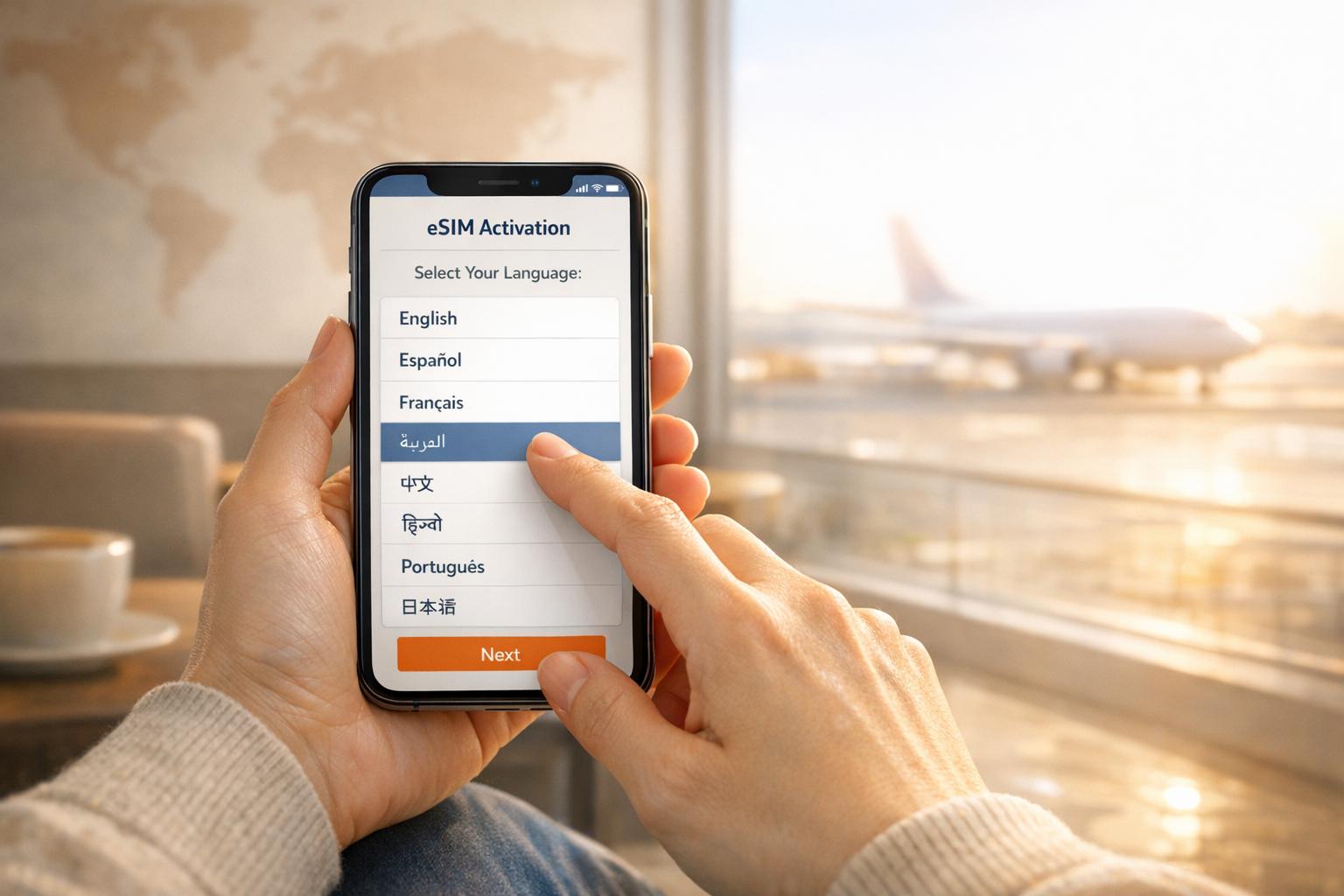
eSIMs let you activate mobile data plans digitally without needing a physical SIM card, making them ideal for travellers. However, language barriers can make setup frustrating, especially in foreign countries. Multi-language support solves this by offering instructions in users’ native languages, simplifying activation and boosting confidence.
Key takeaways:
- Why it matters: Clear, localised instructions reduce errors and improve user satisfaction.
- Case in point: Platforms like ZIM Connections support 40+ languages, enabling smoother onboarding for travellers in over 200 destinations.
- Adoption trends: Global eSIM downloads are expected to exceed 1 billion by 2025, with localisation playing a major role in driving adoption.
- Challenges: Accurate translations and adapting user interfaces for different languages require careful planning and resources.
Providing multi-language support ensures eSIM technology is accessible to a global audience, bridging gaps for non-English speakers and encouraging wider adoption.
Global eSIM Adoption Statistics and Multi-Language Support Impact 2024-2025
How Multi-Language Support Improves User Satisfaction
Better Accessibility and Ease of Use
Language barriers can make getting a local SIM card abroad a frustrating experience. Multi-language support on eSIM platforms removes this obstacle by offering digital connectivity in a traveller’s preferred language. This means no more struggling to explain technical requirements in a foreign mobile shop or navigating unfamiliar processes.
Clear instructions in a native language make activation much simpler. Steps like scanning QR codes or manual installation become straightforward, reducing the chances of errors. For instance, platforms like ZIM Connections guide users through activation in multiple languages, allowing them to set up their eSIMs with confidence.
A user-friendly interface in the traveller’s own language also simplifies managing multiple international profiles and data plans. Instead of dealing with different apps or systems in various languages, users can seamlessly switch between profiles, track data usage, and tweak settings – all in a language they fully understand.
This ease of use not only streamlines the initial setup but also builds user confidence from the start.
Greater Trust and User Confidence
Providing interfaces in native languages helps overcome adoption challenges for eSIM technology. Localised platforms allow travellers to clearly understand the benefits of travel eSIMs. When details about data plans, coverage, and pricing are presented in a familiar language, users are better equipped to make informed choices.
A GSMA Intelligence survey conducted in August 2024, involving 12,000 consumers across 12 countries, highlighted that reducing complexity during the provisioning process directly boosts user trust. With less need for external assistance, users feel more self-reliant and confident in using the technology.
These improvements in clarity and trust are further supported by market trends.
Research Data on User Satisfaction
Recent research backs up the benefits of these user-friendly features. A study by Counterpoint Research in late 2024 surveyed 3,535 participants across seven countries – the US, Canada, the UK, France, Germany, Japan, and Poland – to gauge sentiment towards travel eSIMs. The findings show that international roaming continues to be a key driver of consumer interest in eSIM technology as of 2025. Localised experiences play a crucial role in improving conversion rates.
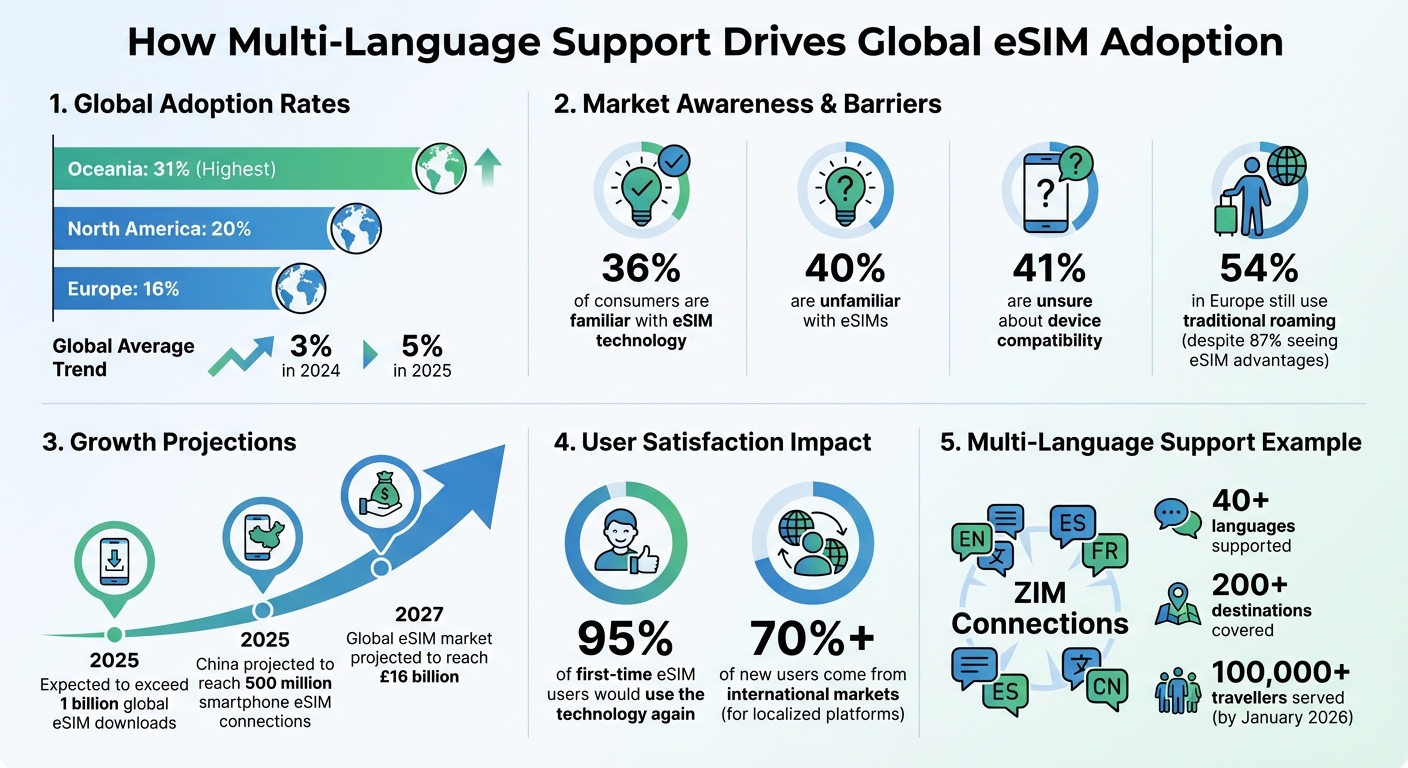
However, awareness of eSIM technology remains low, with only 36% of consumers in major markets familiar with it. This highlights the need for educational resources – like troubleshooting guides, FAQs, and support documentation – available in multiple languages to encourage adoption. Multi-language support is particularly vital during the activation phase, reducing drop-offs and ensuring a smoother user journey.
The GSMA predicts that global eSIM downloads will exceed 1 billion by 2025. Making eSIM technology accessible to non-English speakers through multi-language support will be key to reaching this milestone.
Impact of Multi-Language Support on eSIM Adoption Rates
Adoption Trends in Multilingual Markets
eSIM adoption rates show clear regional differences: Oceania leads with 31%, followed by North America at 20%, and Europe at 16% as of summer 2025. These figures highlight the importance of native-language communication in encouraging adoption.
In Europe, while 87% of people see the advantages of eSIMs for travel, 54% still stick with traditional roaming services due to the convenience of ‘Roam Like at Home’ regulations. Multi-language support is helping to ease this transition by reducing the intimidation factor for users hesitant to switch from familiar options.
In regions like Latin America, where cost is a major factor and 44% of travellers rely on free WiFi, providing pricing details in local languages builds trust and helps people make informed decisions. The global eSIM adoption rate climbed to 5% in 2025, up from 3% in 2024, and localised interfaces have played a crucial role in driving this growth.
Higher Conversion Rates Through Localisation
Language barriers often fuel consumer hesitation. For instance, 40% of people are unfamiliar with eSIMs, and 41% are unsure if their devices are compatible. Platforms that offer clear, native-language explanations – covering everything from checking if an iPhone 16 or Samsung Galaxy S25 supports eSIM to setting up profiles with QR codes – help break down these barriers.
Localised interfaces simplify the activation process by guiding users step-by-step in their own language. The results are impressive: 95% of first-time eSIM users report they would use the technology again. Once users overcome both linguistic and technical challenges, they tend to stick with eSIMs.
"Once users discover how they can get connectivity with eSIM, they don’t really want to go back to the old way [physical SIMs]." – Bahadir Ozdemir, CEO, Airalo
As digital-first onboarding and eSIM-only models like the iPhone Air and Pixel 10 become more prevalent, multi-language support becomes essential for global reach. Without clear, localised instructions, non-English speakers risk being left behind, slowing adoption in key markets.
The improvements in conversion rates pave the way for practical applications, as seen in ZIM Connections’ strategy.
Case Study: ZIM Connections‘ Multilingual Strategy
ZIM Connections provides a textbook example of how multi-language support accelerates adoption. By January 2026, the platform had grown to serve over 100,000 travellers worldwide, offering services in 40 languages, including Arabic, Chinese (Simplified), French, German, Hindi, Japanese, Russian, and Spanish. This expansive localisation effort supports their operations across 200+ destinations.
The platform addresses common traveller challenges by allowing users to check device compatibility, filter plans based on duration, and complete QR code installations – all in their preferred language. This eliminates language-related barriers during activation, a critical point where many users might otherwise abandon the process.
China’s market highlights the importance of this approach. Expected to lead the world with 500 million smartphone eSIM connections by 2025, China’s easing of eSIM restrictions following the launch of the eSIM-only iPhone Air is likely to drive adoption across Asia. Platforms with Simplified Chinese interfaces are well-positioned to tap into this growth, as many users still find the technology unfamiliar and need clear guidance.
"People might experience eSIM for the first time whilst travelling. These users who like the eSIM experience would go back home and request their network providers to make a switch from a physical SIM." – Pablo Iacopino, Analyst, GSMA
This insight demonstrates how positive travel experiences with eSIMs – enhanced by multi-language support – can influence broader adoption. When travellers successfully use eSIMs abroad with clear, native-language instructions, they often return home as advocates for the technology, accelerating its acceptance in their local markets.
sbb-itb-273ea09
Challenges in Implementing Multi-Language Support
While offering multi-language support can boost adoption rates, implementing it comes with a mix of technical and linguistic hurdles.
Translation Accuracy and Consistency
Technical translations for eSIM platforms are particularly tricky. Terms like "EID", "SM-DP+ address", and "eUICC" often confuse automated tools. For example, DeepSeek scored 3.5/5 in translation tests, outperforming Google’s Bard, which managed only 2.1/5. These tools frequently misinterpret technical instructions, which can frustrate users during the activation process.
Another issue is the lack of centralised glossaries, leading to inconsistent use of terminology. This inconsistency becomes even more pronounced when dealing with dialect variations, such as Brazilian versus European Portuguese or regional Spanish variants.
"Issues with accuracy can cause a considerable impact and may confuse or mislead the reader." – Lokalise
To tackle these problems, many platforms use translation memory systems. These systems store approved translations for reuse, ensuring consistency and cutting costs. Additionally, high-visibility instructions, like those for activation, often undergo machine translation followed by human editing to improve clarity.
Technical and UI Adaptation Requirements
Translation is just one piece of the puzzle – adapting user interfaces (UIs) for multiple languages is another challenge entirely. For eSIM platforms, this means accounting for manufacturer-specific terminology. For instance, Apple uses "Mobile Data", Samsung has "SIM manager", and Google Pixel opts for "Network & internet". This variation requires device-specific guides that reflect the exact menu paths users will see.
Language differences also affect UI design. For example, German translations can be up to 30% longer than their English counterparts, potentially disrupting layouts. Push notifications tied to eSIM installation add another layer of complexity, as they need to trigger correctly based on the device’s language settings, which varies across operating systems.
Another technical hurdle is offering multiple activation pathways. While QR code scanning is the most common method, platforms should also provide manual options, like entering SM-DP+ addresses or activation codes, in the user’s preferred language. This redundancy helps minimise support requests and reduces the likelihood of users abandoning the activation process.
Solutions and Best Practices
To address these challenges, a proactive approach is essential. One effective method is adopting a Localisation Maturity Model, which helps organisations move from ad hoc translations to streamlined systems that allocate resources efficiently. Companies that collaborate with localisation specialists often see significant results – some report that over 70% of new users come from international markets, highlighting the importance of well-executed localisation.
Automation and centralisation can also make a big difference. Automating content exchanges and quality assurance reviews speeds up the process while reducing errors.
"An optimised localisation programme is a finely tuned engine powering your global business objectives. You know what works, you know how to replicate success in different situations and different markets." – Acclaro
Instead of aiming for exhaustive translation coverage from the outset, platforms should prioritise high-impact markets. Offering 24/7 multilingual chat support is another effective strategy, especially for travellers who may need immediate assistance across time zones.
Overcoming these challenges is crucial to maintaining the seamless user experience that encourages wider adoption of eSIM technology.
Conclusion
Multi-language support plays a key role in offering a smooth user experience and encouraging the global uptake of eSIM technology. While research shows that international travel remains the primary driver for eSIM use, adoption in non-English-speaking regions still lags behind availability. This disparity often stems from whether users can access platforms in their preferred languages.
Using a native language to navigate technical processes not only reduces mistakes but also boosts user confidence. This leads to higher satisfaction and improved conversion rates. A standout example is ZIM Connections, which offers its platform in over 40 languages and ensures reliable connectivity across more than 200 destinations. By tailoring every step to local needs, ZIM Connections strengthens user trust while offering cost-effective and efficient solutions for travellers and global teams alike.
Although challenges like ensuring accurate translations and adapting interfaces exist, they are manageable. With the global eSIM market expected to reach approximately £16 billion by 2027, providers that focus on localisation will be better placed to attract a growing international audience.
FAQs
How does multi-language support make eSIM activation easier for non-English speakers?
Multi-language support makes eSIM activation much easier by offering instructions, prompts, and interfaces in a user’s native language. This removes potential confusion and helps users follow the steps clearly, reducing mistakes and making the entire process straightforward.
For those who don’t speak English, being able to access instructions in their own language boosts confidence and creates a hassle-free experience. By addressing the needs of a global audience, this approach not only improves user satisfaction but also encourages more people to adopt eSIM technology. It fosters trust and ensures staying connected across different places is simple and stress-free for everyone.
What challenges do eSIM platforms face when offering multi-language support?
Implementing multi-language support for eSIM platforms is no small feat. It’s not just about translating words – it’s about localising content so it truly connects with users in different regions. This means ensuring the language feels natural and avoids any cultural missteps that could confuse or frustrate users.
On top of that, integrating multiple language options without compromising platform performance or security adds another layer of complexity. This is especially tricky when dealing with remote provisioning and device activation, where precision and reliability are critical. And then there’s the challenge of maintaining a consistent, intuitive interface across languages. Factors like script direction (think left-to-right versus right-to-left), varying character sets, and layout adjustments all come into play.
Take global services like ZIM Connections, for example. Operating in over 200 destinations, they need to ensure their multilingual support keeps pace with changing languages and technologies. Why? So users can activate and manage their eSIMs effortlessly, no matter where they are or what language they speak.
Why is multi-language support important for boosting global eSIM adoption?
Making eSIM platforms accessible in multiple languages is key to driving their adoption across the globe. When users can access information, instructions, and support in their native language, the entire process – whether it’s activation, managing plans, or troubleshooting – becomes far simpler and more intuitive. This not only enhances the user experience but also builds trust, especially for those less familiar with how eSIM technology works.
Another important factor is localisation. Tailoring the platform to regional preferences – like using local currencies (£), date formats (DD/MM/YYYY), and language nuances – creates a sense of comfort and familiarity. Take the UK as an example: communicating in British English and showing prices in pounds can make users feel more confident and willing to embrace the technology. By addressing language barriers and aligning with local expectations, eSIM providers can encourage broader global adoption and make the technology more approachable for everyone.